Rise in national resilience of coalition supporters vs. steep decline among supporters of the opposition




Research
Rise in national resilience of coalition supporters vs. steep decline among supporters of the opposition
A joint study by researchers from Tel Aviv University and the Tel-Hai Academic College demonstrates scientifically what we have all noted in the media, in the social networks, and in the streets: while the national resilience of coalition supporters has risen significantly over the past year (from 3.5 to 3.9 on a scale of 1-6), the opposite is true for supporters of the opposition, who exhibited a steep decline in the index of national resilience (from 3.7 in October 2022 to 3.2 in August 2023).
The study was led by Prof. Shaul Kimhi, Prof. Bruria Adini, Dr. Maya Siman-Tov, and Arielle Kaim from the Department of Emergency and Disaster Management, School of Public Health, at Tel Aviv University, and Prof. Yohanan Eshel and Dr. Hadas Marciano from the Tel-Hai College and the University of Haifa.
The researchers explain that the study is based on three surveys within the same sample of Jewish Israelis (N=785): the first a short time before the last elections (October 2022), the second in February 2023, about three and a half months after the elections, in the midst of the constitutional overhaul, and the third at the beginning of August 2023. The study examined a range of parameters related to resilience, stress, and well-being: national resilience, personal resilience, hope, morale, distress symptoms, and sense of danger. Average national resilience scores among supporters of the current coalition indicate a statistically significant rise from 3.53 in the first survey to 3.85 in the third, while supporters of the present opposition showed a significant decline from 3.66 in the first to 3.20 in the third measurement. It should be noted that in the first survey supporters of the current opposition (who were then supporters of the ruling government) reported significantly higher national resilience compared to coalition supporters.
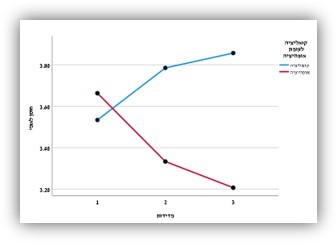
Illustration: Comparison between coalition and opposition supporters through 3 assessments of national resilience:
In the parameter of hope for a better future, the study indicates no statistically significant change in the average score of the whole sample between the first (3.53) and second (3.52) surveys. In the third survey, however, a steep decline was observed in the overall score – down to 3.17. At the same time, findings indicate a large gap between opposition and coalition supporters: while coalition supporters maintained a relatively high level of hope in all three surveys (3.6), hope among supporters of the opposition dropped from 3.4 to 2.8 (measured on a scale of 1-5).
"The findings arouse deep concern for our ability to deal with the multitude of threats facing us and pose a danger to our existence as a healthy and cohesive society”.
The parameter of personal resilience further demonstrates the impact of the constitutional overhaul on the Israeli public. The study's findings indicate a sharp decline in the overall score through all three surveys - from 3.9 to 3.5 (scale of 1-5). This substantial decline in personal resilience levels was observed in both groups (coalition and opposition supporters), with no significant difference throughout the three surveys. In other words, all participants reported a decrease in their personal resilience.
As to the sense of danger parameter, as expected, supporters of the opposition reported that they felt a real threat to themselves and to the state, and their apprehension was expressed in a sharp rise (from 2.3 to 2.9). Coalition supporters, on the other hand, felt much safer, and this was expressed in a decrease (from 2.6 to 2.1) on a scale of 1-5.
From their findings, the researchers conclude that since the elections of November 2022, the gap between the two groups representing Israel's Jewish population – coalition and opposition supporters – has increased constantly. In all parameters measured in the study it is apparent that following the elections and ensuing events, supporters of the opposition reported a significant drop in resilience measures - national resilience, personal resilience, hope for a better future, and morale, coupled with a rise in distress symptoms and the sense of danger. In addition, findings indicate that following the elections, the gap between the two groups has deepened, which leads to further exacerbation of the severe political/social crisis in which Israel finds itself today.
Prof. Bruria Adini added: “Studies have shown that the national (societal) resilience index is a good predictor of a society’s capacity to withstand varied crises. The current study presents rapidly growing rifts and a continually decreasing level of resilience in Israeli society. The findings arouse deep concern for our ability to deal with the multitude of threats facing us, and pose a danger to our existence as a healthy and cohesive society”.

Research
Researchers from Tel Aviv University develop nanoparticles containing RNA molecules, similar to those used in the COVID-19 vaccine, that inhibit the ability of cancer cells to divide
Researchers at Tel Aviv University destroyed 90% of the multiple myeloma blood cancer cells under laboratory conditions, and 60% in human tissues taken from patients at Rabin Medical Center (Belinson Hospital), using an RNA-based drug delivered to the cells by targeted lipid nanoparticles.
The researchers developed lipid-based nanoparticles (approximate to those used in the COVID-19 vaccine) containing RNA molecules that silence the gene CKAP5, encoding cytoskeleton-associated protein 5. With this protein inhibited the cancer cell is unable to divide, which essentially kills it. To avoid damaging noncancerous cells, the nanoparticles were coated with antibodies that guided them specifically to the cancer cells inside the bone marrow.
The breakthrough was achieved by a group of researchers from Tel Aviv University and the Rabin Medical Center, led by Prof. Dan Peer, a pioneer in the development of RNA therapeutics and Head of the Nanomedicine Laboratory at the Shmunis School of Biomedicine and Cancer Research, also serving as TAU's VP R&D, and by PhD student Dana Tarab-Ravski. The results were published in the leading journal Advanced Science.
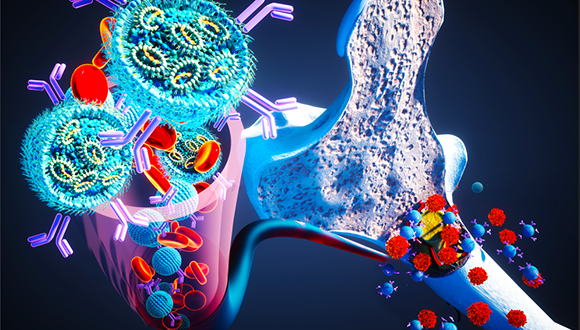
Cover image for Advanced Science (credit: Ella Maru Studio)
"The targeted drug delivery system we developed is the first to effectively reach cancer cells inside the bone marrow."
Dana Tarab-Ravski explains: “Multiple myeloma is a blood cancer usually found in the older population. While most blood cancers appear in the blood stream or lymph nodes and spread from there to the rest of the body, multiple myeloma cells appear and form tumors inside the bone marrow – and are therefore very hard to reach."
The study's findings are very encouraging: under laboratory conditions, where cells are grown in flasks, the nanoparticles developed by the researchers eradicated about 90% of the cancer cells. At the second stage, the new treatment was tested on cancer samples taken from multiple myeloma patients at the haemato-oncological ward of the Rabin Medical Center. The success rate in these samples was 60%. Testing the ability of the nanoparticles to reach the bone marrow in an animal model, the researchers found that after a single injection the RNA had penetrated to 60% of the multiple myeloma cancer cells in the bone marrow. Lastly, examining the therapeutic effectiveness of the nanoparticles in the animal model resulted in eradication of two thirds of the cancer cells, and the animals showed significant improvement in all clinical indicators.
"People with multiple myeloma suffer from severe pain in their bones, as well as anemia, kidney failure, and a weakened immune system," says Tarab-Ravski. "There are many possible treatments for this disease, but after a certain period of improvement most patients develop resistance to the therapy and the disease relapses even more aggressively. Therefore, there is a constant need for developing new treatments for multiple myeloma. RNA-based therapy has a great advantage in this case because it can be developed very quickly. By simply changing the RNA molecule a different gene can be silenced each time, thereby tailoring the treatment to the progression of the disease and to the individual patient. The challenge in these treatments is to reach the right cells. Today RNA therapeutics are approved for treating a genetic liver disease and for vaccines injected into the muscle, as we saw with the COVID-19 vaccines. The drug delivery system we developed is the first that specifically targets cancer cells inside the bone marrow, and the first to show that silencing the expression of CKAP5 gene can be used to kill blood cancer cells."
Prof. Dan Peer: "Our technology opens a new world for selective delivery of RNA medications and vaccines for cancer tumors and diseases originating in the bone marrow."
The clinical team included Dr. Tamar Berger, Dr. Iuliana Vaxman and Prof. Pia Raanani from the Institute of Hematology, Rabin Medical Center, Beilinson Hospital. The research was funded by the Varda and Boaz Dotan Research Center in Hemato-Oncology at Tel Aviv University and by the Lewis Trust for Blood Cancer Research.

Research
Researchers at Tel Aviv University find correlation between behavioral stress and vaccine effectiveness
Researchers at Tel Aviv University demonstrated for the first time that there is a significant link between behavioral stress and the effectiveness of vaccines. They found that acute stress in lab models 9-12 days after vaccination increases antibody response to the vaccine by 70% compared to the unstressed control group. This, however, comes at the price of reduced antibody breadth, which results in diminished protection against the pathogen's variants.
"Our study was the first to investigate the possible effects of acute stress. We found that this mental state has a dramatic impact – not only on the vaccine's effectiveness, but also on how it works." - Dr. Natalia Freund
The study was carried out in Tel Aviv University and led by Ph.D. student Noam Ben-Shalom from the lab of Dr. Natalia Freund at the Faculty of Medicine and Ph.D. student Elad Sandbank from the Neuro-immunology Lab of Prof. Shamgar Ben-Eliyahu at The School of Psychological Sciences and the Sagol School of Neuroscience. The paper was published on July 6th in the leading scientific journal Brain, Behavior, and Immunity.
Dr. Freund explains: "In this study we examined, for the first time, the correlation between stress and the body's ability to develop an immune response following vaccination. The prevailing assumption is that the effectiveness of a vaccine is determined mainly by its own quality. However, over the years, professional literature has reported influences of other factors as well, such as the age, genetics, and microbiome of the outcomes of vaccination. Our study was the first to investigate the possible effects of acute stress. We found that this mental state has a dramatic impact – not only on the vaccine's effectiveness, but also on how it works."
Acute stress is a mental state caused by immediate threat (either real or imagined), involving the secretion of adrenaline and stimulation. In this study, Dr. Freund and her colleagues vaccinated mice with two different vaccines: the model protein Ovalbumin and a fragment of the SARS-CoV-2 spike protein also used in the COVID-19 vaccine. Nine days later, just as the adaptive immunity became active and the production of antibodies began, the mice were subjected to a widely used behavioral paradigm simulating acute stress. Two and a half weeks after exposure to stress, namely 30 days after vaccination, the level of antibodies in the blood of vaccinated animals that had experienced stress was 70% higher compared to the control group. This phenomenon was observed in animals vaccinated with either type of vaccine.
At the same time, the researchers discovered that the immune system of the animals that had experienced stress was not cross reactive to variants of the protein used in the vaccine. In other words, following stress the immune system was focused entirely on the original vaccine, showing no response to proteins that were only slightly different – such as variants of concern (VOC) of SARS-CoV-2.
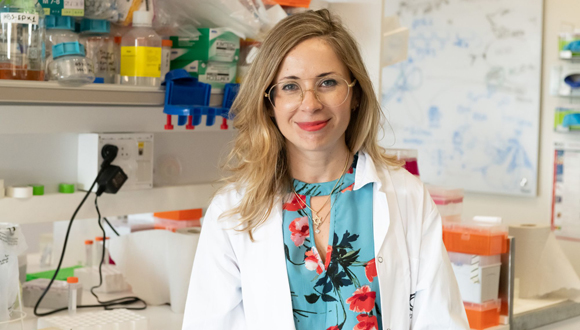
Dr. Natalia Freund
"In general, the purpose of vaccination is not only protection against a specific pathogen, but also creating a long-lasting immunological memory for protection against future mutations of that pathogen." - Dr. Natalia Freund
"Initially, we were surprised to find out that the response to the vaccine was much more effective in animals that had experienced stress," says Dr. Freund, "we would have assumed just the opposite – that stressful situations would have a negative impact on the immune system. Nevertheless, with both types of vaccines, we observed a stronger immune response after stress, both in the blood and in B cells (the lymphocytes that produce antibodies) derived from the spleen and lymph nodes of the immunized mice. The enhancement of the antibodies' activity following stress was mediated by the cellular receptor that identifies adrenaline - the beta2 adrenergic receptor. When we blocked this receptor, either pharmacologically or by means of genetic engineering, the effects of stress were completely eliminated. On the other hand, to our great surprise, the breadth of the immune response generated by the vaccine was reduced by about 50% following stress. In general, the purpose of vaccination is not only protection against a specific pathogen, but also creating a long-lasting immunological memory for protection against future mutations of that pathogen. In this sense, the vaccines appeared to lose much of their effectiveness after exposure to stress."
According to the researchers, this is in fact a classical 'fight or flight' response, however this time demonstrated at the molecular level. During stress, the immune system produces large quantities of antibodies and stronger antibodies, to address the immediate infection, and this large energetic investment in the here and now comes at the expense of future immunological memory.
Dr. Freund adds: "In the second part of the study we wanted to test whether humans also display the post-stress immune impairment observed in vaccinated mice. For this purpose, we cultured B cells obtained from blood of people who had contracted COVID-19 in the first wave. We then induced stress in these cultures using an adrenaline-like substance that stimulates the beta2 adrenergic receptor, that was identified by us in the first part of the study as a mediator of the response to stress in cells that produce antibodies in mice. B cells express a very high level of these receptors, but until now the receptors' role in producing antibodies was not known. In fact, it was unclear why these cells need the ability to respond to adrenaline."
"We discovered that just like in mice, human cells also exhibit a zero-sum game between the intensity and breadth of the immune response. When the adrenaline receptor is activated during stress, the entire immune system is stimulated, generating antibodies that are 100-fold stronger than antibodies produced in cells that had not undergone stress. But here too, the response was narrower: the diversity of antibodies was reduced by 20-100%, depending on the individual from whom the cells were taken.
"Stress 9 to 12 days after vaccination, at the time when B cells are generating high affinity antibodies, enhances short-term immunity and damages long-term memory." – Dr. Natalia Freund
RNA sequencing of the cells in which the beta 2 adrenergic receptor was activated, compared to regular cells, indicated that the receptor's activation caused antibody-producing cells to work at maximum capacity (by activating the PI3 kinase protein and phosphorylation of AKT) - at the expense of antibody breadth and diversity."
"From the evolutionary perspective," concludes Dr. Freund, "stress can be caused by different factors. We tend to think of mental stress, but physical illness also causes a form of stress. When the body contracts a virus or bacteria it experiences stress, and signals to the immune system that the top priority is getting rid of the pathogen, while investing energy in long-term immunological memory is a second priority. Therefore, stress 9 to 12 days after vaccination, at the time when B cells are generating high affinity antibodies, enhances short-term immunity and damages long-term memory."

Research
Early humans in Israel's Hula Valley invested in systematic procurement of raw materials hundreds of thousands of years ago – much earlier than previously assumed
A new study from Tel Aviv University and Tel-Hai College solves an old mystery: Where did early humans in the Hula Valley, in northern Israel, get flint to make the prehistoric tools known as hand axes? The researchers applied advanced methods of chemical analysis and AI to identify the geochemical fingerprints of hand axes from the Hula Valley's oldest prehistoric sites, Ma'ayan Barukh and Gesher Benot Ya'aqov. Their findings indicate that the raw material came from exposures of high-quality flint in the Dishon Plateau, about 20km to the west, and hundreds of meters above the Hula Valley. The researchers: "Our findings indicate that these early humans had high social and cognitive abilities: they were familiar with their surroundings, knew the available resources, and made great efforts to procure the high-quality raw materials they needed. For this purpose, they planned and carried out long journeys, and transferred this essential knowledge to subsequent generations."
"Our findings indicate that early humans were highly capable: they planned and implemented complex strategies and passed on essential information from one generation to the next." - The researchers
The study was led by Dr. Meir Finkel of the Department of Archaeology and Ancient Near East Cultures, Tel Aviv University and Prof. Gonen Sharon of the MA Program in Galilee Studies, Tel-Hai College, in collaboration with Prof. Erez Ben-Yosef, Tel Aviv University, Dr. Oded Bar and Dr. Yoav Ben Dor, the Geological Survey of Israel, and Ofir Tirosh, the Hebrew University. The paper was published in Geoarchaeology.
Dr. Finkel: "The Hula Valley, located along the Dead Sea Transform Rift, is well known for its many prehistoric sites, the oldest of which date back to 750,000 years before present (YBP). The valley offered early humans rich sources of water, vegetation, and game, right on the northward migration route from Africa - the Great African Rift Valley. These early inhabitants left behind them many artifacts, including thousands of hand axes – flint stones chiseled to fit the human hand. One of the earliest and most universal tools produced by humans, the hand axe may have served as a multipurpose 'penknife' for many different tasks, from cutting game meat to digging for water and extracting roots. It was used in many different parts of the Old World, in Africa, Asia, and Europe, for about 1.5 million years."
"One of the earliest and most universal tools produced by humans, the hand axe may have served as a multipurpose 'penknife' for many different tasks, from cutting game meat to digging for water and extracting roots." - Dr. Meir Finkel
In the present study the researchers looked for the source of the raw material used to produce thousands of hand axes found at two prehistoric sites in the Hula Valley: Gesher Benot Ya'aqov, dated to 750,000 YBP and Ma'ayan Barukh, dated to 500,000 YBP, both Acheulian. Prof. Sharon: "Approximately 3,500 hand axes were found scattered on the ground at Ma'ayan Barukh, and several thousands more were discovered at Gesher Benot Ya'aqov. The average hand axe, a little over 10cm long and weighing about 200g, was produced by reducing stones that are five times larger – at least 1kg of raw material. In other words, to make the 3,500 hand axes found at Ma'ayan Barukh alone, early humans needed 3.5 tons of flint. But where did they obtain such a huge amount of flint? Many researchers have tried to answer this question, but our study was the first to use innovative 21st century technologies: advanced chemical analysis and an AI algorithm developed specifically for this purpose."
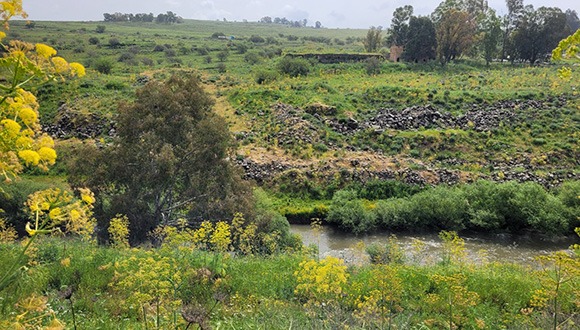
The Gesher Benot Ya'aqov area
The researchers took samples from 20 hand axes – 10 from Gesher Benot Ya'aqov and 10 from Ma'ayan Barukh, ground them into powder and dissolved the powder in acid in a clean lab. For each sample they measured the concentration of approximately 40 chemical elements, using an ICP-MS (inductively coupled plasma mass spectrometer), a state-of-the-art device that accurately measures the concentration of dozens of elements, down to a resolution of one particle per billion.
In addition, in order to locate possible flint sources available to the Hula Valley's prehistoric inhabitants, the researchers conducted a field survey covering flint exposures in the Safed Mountains, Ramim Ridge, Golan Heights, and Dishon Plateau, as well as cobbles from streams draining into the Hula Valley: the Jordan, Ayun, Dishon, Rosh Pina, and Mahanayeem. This methodical survey was combined with a comprehensive literature review led by Dr. Bar of the Geological Survey of Israel. Flint samples collected from all potential sources were then analyzed using ICP-MS technology to enable comparison with the hand axes. A novel computational approach specially adapted by Dr. Ben Dor of the Geological Survey of Israel was used for this comparison.
Dr. Ben Dor: "The complex process, from collecting and preparing the samples to the chemical analysis, produced a very large amount of data for each sample. To enable optimal matching between data from the archaeological artifacts and data from the flint exposures, we developed a dedicated algorithm based on several computational steps, alongside machine learning models. Thus, we were able to classify the archaeological artifacts according to the database derived from the geological samples."
"To procure suitable raw materials for producing their vital hand axes, [humans living in the Hula Valley hundreds of thousands of years ago] planned and carried out 20km hikes that included an ascent from 70 to 800 meters above sea level." Prof. Erez Ben-Yosef
Dr. Finkel: "Through the computational process we discovered that all 20 archaeological artifacts were made of flint from a single source: the Dishon Plateau's flint exposures dating back to the Eocene geological epoch, about 20km west of the Gesher Benot Ya'aqov and Ma'ayan Barukh sites. At the Dishon Plateau we also found a prehistoric flint extraction and reduction complex, indicating that the place served as a flint source for hundreds of thousands of years. In addition, we demonstrated that cobbles from streams draining into the Hula Valley were too small to be used as raw material for hand axes, ruling out this possibility."
Kadar Family Award for Outstanding Research recipient Prof. Ben-Yosef: "Our findings clearly indicate that humans living in the Hula Valley hundreds of thousands of years ago, probably hominids of the homo erectus species, possessed high cognitive and social capabilities. To procure suitable raw materials for producing their vital hand axes, they planned and carried out 20km hikes that included an ascent from 70 to 800 meters above sea level. Moreover, they passed on this important knowledge from one generation to the next, over many millennia. All these suggest a high level of sophistication and ability, which modern researchers do not usually attribute to prehistoric humans from such an early period."

From left: Dr. Meir Finkel and Prof. Erez Ben-Yosef

Research
Initial hope for mass production of green hydrogen, which will dramatically reduce global CO2 emissions
Tel Aviv University researchers have achieved a groundbreaking milestone by successfully producing highly efficient and low-cost “green” hydrogen. By harnessing the power of green electricity and utilizing a highly efficient biocatalyst, this innovative process generates hydrogen without any air pollution.
Hydrogen plays a vital role as raw material in both agriculture and industry. However, most of the hydrogen produced globally, approximately 95%, falls in the “black” or “gray” category. These types of hydrogen are derived from coal or natural gas, emitting a significant 9-12 tons of carbon dioxide for every ton of hydrogen produced.
The new method was developed by doctoral student Itzhak Grinberg and Dr. Oren Ben-Zvi, under the guidance of Prof. Iftach Yacoby of the School of Plant Sciences and Food Security at the Wise Faculty of Life Sciences and Prof. Lihi Adler-Abramovich of the Goldschleger School of Dental Medicine and the Center for Nanoscience and Nanotechnology. The promising research results were published in the prominent journal Carbon Energy, focusing on advanced materials and technology for clean energy and CO2 emission reduction.
“Hydrogen is very rare in the atmosphere,” explains Itzhak Grinberg, “although it is produced by enzymes in microscopic organisms, which receive the energy for this from photosynthesis processes. In the lab, we 'electrify' those enzymes, that is, an electrode provides the energy instead of the sun. The result is a particularly efficient process, with no demand for extreme conditions, that can utilize electricity from renewable sources such as solar panels or wind turbine. However, the enzyme ‘runs away’ from the electric charge, so it needs to be held in place through chemical treatment. We found a simple and efficient way to attach the enzyme to the electrode and utilize it.”
The researchers used a hydrogel (a water-based gel) to attach the enzyme to the electrode and were able to produce green hydrogen using a biocatalyst, and with over 90% efficiency; that is, over 90% of the electrons introduced into the system were deposited in the hydrogen without any secondary processes.
“We hope that in the future, it will be possible to employ our method commercially, to lower the costs, and to make the switch towards using green hydrogen in industry, agriculture, and as a clean energy source.” - Dr. Oren Ben-Zvi
Prof. Iftach Yacoby explains that, “The material of the gel itself is known, but our innovation is to use it to produce hydrogen. We soaked the electrode in the gel, which contained an enzyme for producing hydrogen, called hydrogenase. The gel holds the enzyme for a long time, even under the electric voltage, and makes it possible to produce hydrogen with great efficiency and at environmental conditions favorable to the enzyme — for example, in salt water, in contrast to electrolysis, which requires distilled water.
Prof. Lihi Adler-Abramovich adds: “Another advantage is that the gel assembles itself — you put the material in water, and it settles into nanometric fibers that form the gel. We demonstrated that these fibers are also able to stick the enzyme to the electrode. We tested the gel with two other enzymes, in addition to the hydrogenase, and proved that it was able to attach different enzymes to the electrode.”
“Today, ‘green’ hydrogen is produced primarily through electrolysis, which requires precious and rare metals such as platinum along with water distillation, which makes the green hydrogen up to 15 times more expensive than the polluting ‘grey’ one, says Dr. Oren Ben-Zvi. “We hope that in the future, it will be possible to employ our method commercially, to lower the costs, and to make the switch towards using green hydrogen in industry, agriculture, and as a clean energy source.”

Research
Tel Aviv University's breakthrough study unleashes self-produced toxin, targeting and eliminating cancer cells with impressive results
For the first time in the world: researchers at Tel Aviv University encoded a toxin produced by bacteria into mRNA (messenger RNA) molecules and delivered these particles directly to cancer cells, causing the cells to produce the toxin – which eventually killed them with a success rate of 50%.
"Our idea was to deliver safe mRNA molecules encoded for a bacterial toxin directly to the cancer cells – inducing these cells to actually produce the toxic protein that would later kill them. It's like placing a Trojan horse inside the cancer cell." - Prof. Dan Peer
The groundbreaking study was led by PhD student Yasmin Granot-Matok and Prof. Dan Peer, a pioneer in the development of RNA therapeutics and Head of the Nanomedicine Laboratory at The Shmunis School of Biomedicine and Cancer Research, also serving as TAU's VP R&D. The study's results were published in Theranostics.
Prof. Peer explains: "Many bacteria secrete toxins. The most famous of these is probably the botulinum toxin injected in Botox treatments. Another classic treatment technique is chemotherapy, involving the delivery of small molecules through the bloodstream to effectively kill cancer cells. However, chemotherapy has a major downside: it is not selective, and also kills healthy cells. Our idea was to deliver safe mRNA molecules encoded for a bacterial toxin directly to the cancer cells – inducing these cells to actually produce the toxic protein that would later kill them. It's like placing a Trojan horse inside the cancer cell."
Prof. Dan Peer
First, the research team encoded the genetic info of the toxic protein produced by bacteria of the pseudomonas family into mRNA molecules (resembling the procedure in which genetic info of COVID-19's 'spike' protein was encoded into mRNA molecules to create the vaccine). The mRNA molecules were then packaged in lipid nanoparticles developed in Prof. Peer's laboratory and coated with antibodies - to make sure that the instructions for producing the toxin would reach their target, the cancer cells. The particles were injected into the tumors of animal models with melanoma skin cancer. After a single injection, 44-60% of the cancer cells vanished.
"With a simple injection to the tumor bed, we can cause cancer cells to 'commit suicide', without damaging healthy cells. Moreover, cancer cells cannot develop resistance to our technology as often happens with chemotherapy – because we can always use a different natural toxin." - Prof. Dan Peer
"In our study, the cancer cell produced the toxic protein that eventually killed it," says Prof. Peer. "We used pseudomonas bacteria and the melanoma cancer, but this was only a matter of convenience. Many anaerobic bacteria, especially those that live in the ground, secrete toxins, and most of these toxins can probably be used with our method. This is our 'recipe', and we know how to deliver it directly to the target cells with our nanoparticles. When the cancer cell reads the 'recipe' at the other end it starts to produce the toxin as if it were the bacteria itself and this self-produced toxin eventually kills it. Thus, with a simple injection to the tumor bed, we can cause cancer cells to 'commit suicide', without damaging healthy cells. Moreover, cancer cells cannot develop resistance to our technology as often happens with chemotherapy – because we can always use a different natural toxin."
Other contributors to the study included: Dr. Assaf Ezra, Dr. Srinivas Ramishetti, Dr. Preeti Sharma Dr. Gonna Somu Naidu and Prof. Itai Benhar, Head of the Antibody Engineering Lab at the Shmunis School of Biomedicine and Cancer Research at TAU. The study was funded by the Shmunis Family Foundation for Biomedicine and Cancer Research.