

Through Foreign Eyes: How Filmmakers Captured a Young Israel
What were international filmmakers searching for in the young State of Israel, what did they find here, and what can their films teach us about the Israel of then and today?
What were international filmmakers searching for in the young State of Israel, what did they find here, and what can their films teach us about the Israel of then and today?


Dr. Ohad Landesman
14/09/2026

“A chosen people, a wandering people, a tormented people, a murdered people, a people reborn. Israel has known struggle in all its forms.”
With these words, French filmmaker Chris Marker opens his 1960 documentary Description of a Struggle (Description d'un combat).
Marker came to Israel not to provide clear answers, but to try to understand a young country in the process of shaping its identity—and, in doing so, to reconsider some of his own perceptions. Yet seven years after the film was released, following the Six-Day War, Marker sought to limit its screenings. In his view, the political reality had changed so dramatically that the film no longer reflected his positions.
The film, which was barely screened in Israel for decades, became the starting point more than 60 years later for research by Dr. Ohad Landesman of the Steve Tisch School of Film and Television, supported by the Israel Science Foundation (ISF). Landesman’s research led to his book, Brief Encounters: Documentary Visits to an Imagined Israel, published this year by SUNY Press.
This story led Landesman to search for other filmmakers who visited Israel during the 1960s and 1970s, among them Pier Paolo Pasolini, Susan Sontag, and Claude Lanzmann. In their films, he found not only documentation of a young Israel, but also the perspectives of outsiders who came here to explore questions that preoccupied them personally.
These films returned to the screen at the 2026 Docaviv Film Festival as part of Imagined Land, a program curated by Landesman. The four films screened drew large audiences, with some screenings completely sold out. The response surprised Landesman somewhat—but also demonstrated just how relevant the research remains today.
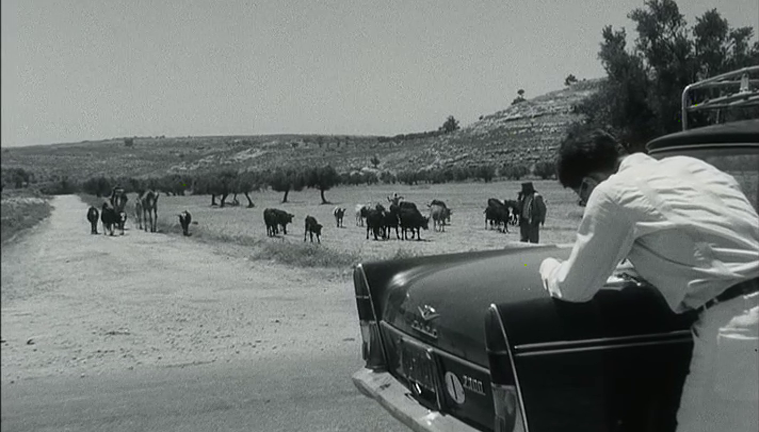
From Location Hunting in Palestine, 1963. (Credit: Cineteca Nazionale)
Who Were the “Brief Encounters” and Why Israel?
They were some of the most prominent names in the cultural and cinematic world of their time. They came to Israel for short periods—sometimes just a few weeks—and were not attempting to conduct lengthy anthropological journeys. They arrived with questions, expectations, and sometimes a preconceived image of the country. They filmed, observed, and returned home.
But why Israel? For these filmmakers, Israel was far more than a place to make a film. The young country was perceived as a kind of “laboratory of ideas”: a place where major questions about the Holocaust and rebirth, Zionism, religion, nationalism, war, and socialism converged.
Some arrived with sympathy for and curiosity about the Zionist project, while others sought to examine the gap between the image of Israel and the reality they encountered. For all of them, to varying degrees, Israel became a place through which they could explore larger ideas—and sometimes their own personal positions as well.
Landesman describes these works as “essay films”: films that do not claim to present a complete, objective picture, but instead use documentary filmmaking as a way to think, question, and deliberate. “They are primarily films about the relationship between the filmmaker and the destination, rather than about the destination itself,” Landesman explains.
What You See From Here, You Don’t See From There
Most of the films examined in the research were made between 1960 and 1974, when Israel was still a very young country. The filmmakers arrived with powerful images of the country in mind: a miracle that had emerged from the ruins of the Holocaust, a unique Zionist project, and a society attempting to create a new model of life.
The kibbutz particularly captured their imagination. They saw it as a kind of democratic and socialist bubble—an expression of the new Israeli vision. But their encounter with reality proved more complicated.
Again and again, the films document the gap between the expectations the filmmakers brought with them and what they actually encountered: contradictions, tensions, social and economic disparities, and a reality that did not always correspond to the idealized picture they had imagined.
Precisely because they came from outside, these filmmakers were often able to notice developments that local society—and Israeli cinema at the time—still struggled to see.
Susan Sontag: Seeing the Trauma

From Promised Lands, 1974. (Credit: Cineteca Nazionale)
One striking example is Promised Lands (1974), by Susan Sontag, the prominent American intellectual and cultural figure.
Sontag arrived in Israel immediately after the Yom Kippur War. Rather than documenting the war itself, she became interested in its effects on Israeli society.
One of the film’s most difficult moments takes place at Assaf Harofeh Hospital, where she documents an experimental treatment being given to a soldier suffering from combat trauma. Sontag remains in the room and observes the treatment, which includes a chilling audio reconstruction of the battle played beside the soldier’s bed.
For Landesman, the scene demonstrates the power of an outsider’s perspective: Sontag did not simply document a wounded soldier. Through the experimental treatment of his trauma, she identified something broader—an allegory for a country itself experiencing paranoia, panic, and trauma.
“Not Time Capsules”: Why Do These Films Still Speak to Us Today?

From Description of a Struggle, 1960. (Credit: Cineteca Nazionale)
These films are not “time capsules” that tell us only about the Israel of the 1960s and 1970s. Precisely because they do not offer unequivocal answers, they allow us to reconsider questions that still occupy us today: What does Israel look like from the outside, and how does that differ from the way we see it from within? What are we unable to see that an outsider’s perspective makes visible?
According to Landesman, part of the films’ relevance lies in the fact that some of them still sound prophetic today. At the end of Chris Marker’s 1960 film, for example, the camera focuses on a 12-year-old girl—the same age as the State of Israel that year—as she paints on a canvas. The narration turns to the dangers facing the young country and emphasizes:
“Justice on the soil of Israel will be worse than injustice anywhere else.”
It is a chilling and prophetic moment, and like other moments in the films discussed in the book, it invites viewers to look at Israel through different eyes—and perhaps to look at themselves again as well.
Landesman argues that these films deserve to be revisited in 2026 and remain highly relevant to our present. In the 1960s and 1970s, Israel enjoyed broader international “credit” than it does today, at a time when Israel is perceived as an “outcast” and feels like a “pariah” in the world.
While today’s discourse tends to be dogmatic and polarized, the films Landesman studied offer a more complex perspective. Their creators display considerable intellectual curiosity toward Israel and underscore the need to see the country beyond a one-dimensional political “casting.”
Ultimately, the films made by these “brief visitors” do not provide clear answers about Israel. Instead, they do something else: they formulate questions and bring back a perspective that still allows us to ask those questions anew.
Latest Researches