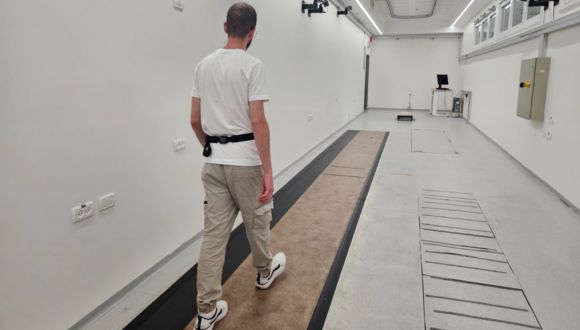
New study tracks step length for neurological disease and aging




Research
New study offers a breakthrough development that may facilitate the use of graphene nanoribbons in nanoelectronics
An international collaborative study that features researchers from TAU presents a new method for growing ultra-long and ultra-narrow strips of graphene (a derivative of graphite), which exhibit semiconducting properties that can be harnessed by the nanoelectronics industry. The researchers believe that the development may have many potential technological applications, including advanced switching devices, spintronic devices, and in the future, even quantum computing architectures. The study was conducted under the leadership of an international research team, that included Prof. Michael Urbakh and Prof. Oded Hod from TAU’s School of Chemistry, as well as scientists from China, South Korea, and Japan. The study was published in the scientific journal Nature.

Prof. Michael Urbakh.
Prof. Urbakh and Prof. Hod explain that graphene is a single layer of graphite made of carbon atoms and built similarly to the shape of a beehive. Graphene is very suitable for technological uses. Apart from its extraordinary mechanical strength, additional properties have been discovered in recent years regarding certain structures made of a small number of twisted (laterally rotated with respect to each other) graphene layers. These properties include superconductivity, spontaneous electric polarization, controlled heat conduction, and structural superlubricity - a state in which materials demonstrate negligible friction and wear.

Prof. Oded Hod.
One of the limitations we find for using graphene in the electronics industry is that it is a semi-metal, namely that charge carriers can move freely in it, but their density is very low. Hence, graphene cannot be used either as a conducting metal or as a semiconductor used by the electronic chip industry.
However, if long and thin strips of graphene (termed graphene nanoribbons) are cut out of a wide graphene sheet, the quantum charge carriers become confined within the narrow dimension, which makes them semi-conducting and enables their use in quantum switching devices. As of today, there are several barriers to using graphene nanoribbons in devices, among them is the challenge of reproducibly growing narrow and long sheets isolated from the environment.
In this new study, the researchers were able to develop a method to catalytically grow narrow, long, and reproducible graphene nanoribbons directly within insulating hexagonal boron-nitride stacks, as well as demonstrate peak performance in quantum switching devices based on the newly-grown ribbons. The unique growth mechanism was revealed using advanced molecular dynamics simulation tools developed and implemented by the Israeli teams. These calculations showed that ultra-low friction in certain growth directions within the boron-nitride crystal dictates the reproducibility of the structure of the ribbon, allowing it to grow to unprecedented lengths directly within a clean and isolated environment.
The researchers see the development as a scientific and technological breakthrough in the field of nanomaterials, one which is expected to open the door to a wide range of studies that will lead to their utilization in the nanoelectronics industry.
Prof. Urbakh and Prof. Hod summarize: "The importance of this new development is that for the first time, it is now possible to fabricate carbon-based nanoelectronic switching devices directly within an isolating matrix. These devices will likely have many technological applications, including electronic and spintronic systems, and even quantum computing devices".

Research
TAU researchers apply the art of origami to advance 3D bioprinting
Researchers at Tel Aviv University relied on principles of origami, the Japanese art of paper folding, to develop an original and innovative solution for a problem troubling researchers worldwide: positioning sensors inside 3D-bioprinted tissue models. Instead of bioprinting tissue over the sensors (found to be impracticable) they design and produce an origami-inspired structure that folds around the fabricated tissue, allowing the insertion of sensors into precisely pre-defined locations.
The study was a joint effort of researchers from several units at TAU: the School of Neurobiology, Biochemistry and Biophysics, the Koum Center for Nanoscience and Nanotechnology, the Department of Biomedical Engineering, the Sagol Center for Regenerative Medicine, the Sagol School of Neuroscience and the Drimmer-Fischler Family Stem Cell Core Laboratory for Regenerative Medicine. The researchers are Noam Rahav, Adi Soffer, Prof. Ben Maoz, Prof. Uri Ashery, Denise Marrero, Emma Glickman, Megane Beldjilali-Labro, Yakey Yaffe, Keshet Tadmor, and Yael Leichtmann-Bardoogo. The paper was published in the leading scientific journal Advanced Science.

The 3D Origami Platform integrated in a 3D printed structure.
Prof. Maoz explains: "The use of 3D-bioprinters to print biological tissue models for research is already widespread. In existing technologies, the printer head moves back and forth, printing layer upon layer of the required tissue. This method, however, has a significant drawback: The tissue cannot be bioprinted over a set of sensors needed to provide information about its inner cells, because in the process of printing the printer head breaks the sensors. We propose a new approach to the complex problem: origami".
MSOP: Where Art Meets Science in Bioprinting
The innovation is based on an original synergy between science with art. Using CAD (Computer Aided Design) software the researchers design a multi-sensing structure customized for a specific tissue model - inspired by origami paper folding. This structure incorporates various sensors for monitoring the electrical activity or resistance of cells in precisely chosen locations within the tissue. The computer model is used to manufacture a physical structure which is then folded around the bioprinted tissue – so that each sensor is inserted into its predefined position inside the tissue. The TAU team has named their novel platform MSOP – Multi-Sensor Origami Platform.
The new method's effectiveness was demonstrated on 3D-bioprinted brain tissues, with the inserted sensors recording neuronal electrical activity. The researchers emphasize, however, that the system is both modular and versatile: it can place any number and any type of sensors in any chosen position within any type of 3D-bioprinted tissue model, as well as in tissues grown artificially in the lab such as brain organoids – small spheres of neurons simulating the human brain.
Origami's Scientific Touch
Prof. Maoz adds: "For experiments with bioprinted brain tissue, we demonstrated an additional advantage of our platform: the option for adding a layer that simulates the natural blood-brain barrier (BBB) – a cell layer protecting the brain from undesirable substances carried in the blood, which unfortunately also blocks certain medications intended for brain diseases. The layer we add consists of human BBB cells, enabling us to measure their electrical resistance which indicates their permeability to various medications".
The researchers summarize: "In this study, we created an 'out-of-the-box' synergy between scientific research and art. We developed a novel method inspired by origami paper folding, enabling the insertion of sensors into precisely predefined locations within 3D-bioprinted tissue models, to detect and record cell activity and communication between cells. This new technology is an important step forward for biological research".