TAU researchers and Sheba Medical Center developed bioengineered skin that accelerates healing time.




Research
TAU researchers and Sheba Medical Center developed bioengineered skin that accelerates healing time.
Researchers from Tel Aviv University and Sheba Tel Hashomer Medical Center have developed an innovative bioengineered skin equivalent for grafting in burn victims. The bioengineered skin produced from the patient’s cells is more stable, robust, and flexible than current treatments, making it easier to handle. A full-thickness wound model, it achieved wound closure in half the time of standard therapies. This pioneering study was driven by the ongoing war and the surge in severe burn injuries, which underscored the urgent need for better treatment solutions.
The groundbreaking study was led by Prof. Lihi Adler-Abramovich and PhD student Dana Cohen-Gerassi from the Laboratory for Bio-Inspired Materials and Nanotechnology at the Goldschleger School of Dental Medicine, at TAU's Gray Faculty of Medical and Health Sciences, in collaboration with: Dr. Ayelet Di Segni, Director of the Sheba Tissue Bank and the Green Skin Engineering Laboratory at Sheba; Dr. Amit Sitt from TAU's School of Chemistry, Faculty of Exact Sciences, Prof. Josef Haik, Head of the Plastic Surgery Division and National Burn Center at Sheba; Dr. Moti Harats, Head of the Israeli National Intensive Care Burn Center at Sheba; Dr. Marina Ben-Shoshan and Dr. Adi Liiani scientists from the Green Skin Engineering Laboratory at Sheba; Prof. Itzhak Binderman from TAU's Goldschleger School of Dental Medicine and Prof. Yosi Shacham-Diamand from TAU's Fleischman Faculty of Engineering, as well as PhD candidate Tomer Reuveni and Offir Loboda from TAU. The paper was published in the prestigious scientific journal Advanced Functional Materials.
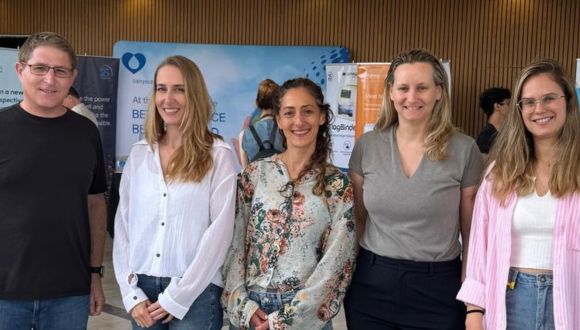
The research team from Tel Aviv University and Sheba Medical Center (From left to right): Dr. Amit Sitt, Dr. Marina Ben-Shoshan, Dr. Ayelet Di Segni, Prof. Lihi Adler-Abramovich & Dana Cohen-Gerassi.
“Surgical intervention is often essential for second-degree burns and above to restore skin, prevent infection, and save lives,” explains Prof. Lihi Adler-Abramovich. “The current gold-standard treatment is ‘autologous skin grafting’, in which healthy skin is harvested from another area of the patient’s body and transplanted onto the burn site. However, this approach has significant disadvantages, particularly the need to damage healthy tissue to treat the injury. This becomes especially problematic in cases of extensive burns, where the availability of intact skin is limited.”
“One of the most advanced alternatives, currently offered in Israel only at Sheba Medical Center, is ‘cultured epidermal autograft’ (CEA). Instead of removing a large skin section, a small biopsy is taken, and cells extracted from that sample are cultured in the lab to produce skin grafts for transplantation. While this method avoids donor-site damage, it comes with several challenges: First, the skin cells are grown on a layer of mouse-derived feeder cells, requiring strict regulation to ensure no mouse cells remain in the graft; Second, once removed from the culture dish, the CEA shrinks by over 50%, significantly reducing yield up to 30 grafts may be needed to cover a single area, such as an arm or leg. Finally, the lab-grown skin consists of only the upper epidermal layer, making it extremely thin, fragile, and prone to curling at the edges.”
The need for advanced solutions is particularly urgent in wartime, with many soldiers suffering from burns. For both soldiers and civilians, a durable bioengineered graft could significantly improve chances for recovery and a good quality of life. “Since October 2023, Sheba has treated many young people with burn injuries,” says Dr. Ayelet Di Segni. “At such a time, bringing knowledge accumulated in the lab directly to the patient's bedside becomes an urgent and tangible goal. We aim to develop a graft that can truly transform the process of recovery.”
To address this challenge, researchers from Tel Aviv University and Sheba Medical Center collaborated to develop multi-cellular, multi-layered bioengineered skin grafts designed to mimic the properties and function of natural skin, without shrinking, tearing upon contact, or relying on animal-derived additives.
“We designed a nanofiber scaffold made of a polymer called PCL, which is already FDA-approved, and combined it with a bioactive peptide - a short amino acid sequence that promotes cell adhesion, growth, and proliferation,” explains PhD student Dana Cohen-Gerassi. “We then seeded this scaffold with skin cells derived from a patient's biopsy. Remarkably, the cells organized themselves naturally: fibroblasts populated one side of the scaffold, while keratinocytes grew on the other - mimicking the structure of real human skin.”
Dr. Marina Ben-Shoshan, senior researcher at Sheba's Green Center for Skin Graft Engineering, adds: “Our graft is unique in that it does not shrink, and is durable, flexible, and easy to handle. Implantation in model animals has yielded impressive results, accelerating the healing process. While the standard treatment closes half of the burn wound in eight days, with our method, this took only four days. Moreover, we observed that essential skin structures, such as hair follicles, began to grow.”
Dr. Amit Sitt from TAU's School of Chemistry adds: “The nanofiber scaffolds are made from easily available biocompatible materials and produced via a scalable spinning process. In the future, this will enable large-scale production of fiber sheets, as well as incorporation of additional substances to facilitate the healing process.”
Prof. Yossi Haik of Sheba Medical Center concludes: “The bioengineered skin we’ve developed represents a true breakthrough in burn care. Made entirely from the patient’s cells, it is strong, flexible, easy to handle, and significantly accelerates healing. This is a major step towards personalized therapies that can greatly improve the recovery and quality of life of severe burn victims, both soldiers and civilians. In the next phase, we plan to conduct trials in additional models and advance the necessary regulatory processes to bring this innovative technology closer to clinical application.”

Research
Researchers from Tel Aviv University used CRISPR to edit thousands of genes in tomato plants.
Researchers from the School of Plant Sciences and Food Security at the Wise Faculty of Life Sciences at Tel Aviv University have developed a genetic editing method tailored to crop plants, which has influenced various traits in tomato plants, including the taste and shape of the fruit. The researchers believe this innovative technology can be applied to various crop species and may eventually be used to cultivate new and improved plant varieties. “We demonstrated that with our technology, it is possible to select specific traits and influence them, a capability that is essential for advancing agriculture and achieving food security,” the researchers stated.
The study was led by Prof. Eilon Shani, Prof. Itay Mayrose and PhD student Amichai Berman (School of Plant Sciences and Food Security at Tel Aviv University) together with PhD student Ning Su and Dr. Yuqin Zhang (University of Chinese Academy of Sciences in Beijing), and Dr. Osnat Yanai from the Israeli Agri-Tech company NetaGenomiX. The article was published in the prestigious journal Nature Communications.
Prof. Shani explains: “Researchers around the world are engaged in advancing agriculture in order to address accelerated global changes and feed the global population in the coming decades. Among other things, genetic editing technologies are being advanced to develop new plant varieties with desirable traits such as resistance to drought, heat, and disease, improved flavor, optimized nutrient usage, and more. One such method is CRISPR-Cas9, which has revolutionized the field of genetic editing by enabling the precise modification of specific genes in the genome.
However, in the realm of agricultural development, this method has encountered several fundamental challenges: Firstly, while CRISPR technology allows for targeted gene editing, until now, this capability was limited in scale - the number of genes that could be edited and studied was very small. In the current study, we significantly improved the method’s efficiency, enabling us to examine the roles of thousands of genes. Secondly, many plants exhibit ‘genetic redundancy’: different genes from the same family, composed of similar amino acid sequences, compensate for one another and preserve the trait even if one gene is deactivated or edited”.
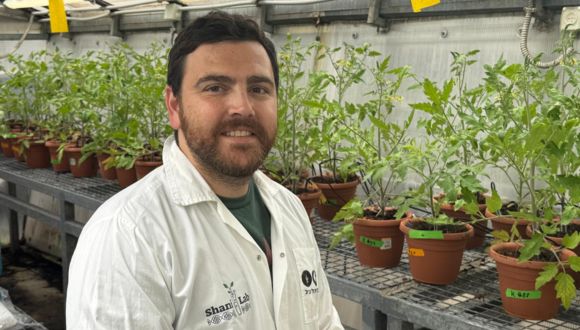
PhD student Amichai Berman.
Amichai Berman: “To overcome genetic redundancy, we aimed to alter entire families of similar genes simultaneously. In a previous study, we developed a breakthrough solution to overcome the issue of genetic redundancy, a dedicated algorithm, and fed it a list of thousands of genes we wanted to edit. The algorithm identified a suitable CRISPR unit for each gene (or gene group) on the list that would induce the desired modification, thereby constructing CRISPR libraries. The first study achieved good results in the model plant Arabidopsis thaliana, and this time we sought to test the method in a crop plant for the first time. We chose the tomato.”
In the current study, the researchers built 10 libraries comprising approximately 15,000 unique CRISPR units targeting the tomato genome - each unit designed to affect a specific gene group from the same family. They then used the CRISPR units to induce mutations in around 1,300 tomato plants, each plant with an alteration in a different gene group. The researchers then tracked the development of each plant to examine whether the selected changes appeared in fruit size, shape, taste, nutrient utilization, or pest resistance. Indeed, the researchers identified several lines with sweetness levels either lower or higher than the control plants.
Prof. Shani concludes: “In this study, using our innovative method, we successfully made targeted genetic changes to gene families in the tomato plant, and identified precisely which genetic edits produced the desired result.” The Israeli Agri-Tech company NetaGenomiX has received a license to commercialize the new technology, with the goal of advancing food security by developing non-GMO crops adapted to the changing climate, providing benefits for both farmers and consumers.
Amichai Berman adds: “We believe our research opens the door to breeding improved varieties for a wide range of crops and also advances the field of plant science as a whole. In follow-up studies, we are working on developing additional selected traits in tomatoes and in rice.”
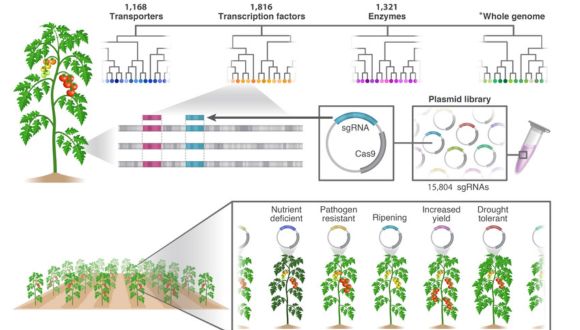
Large-Scale Functional Genomics in Tomato Using a High-Throughput Multi-targeted CRISPR Screening Approach. The tomato plant genome is divided into gene families. For each group of similar genes, a unique CRISPR unit is designed to alter their function (in total, over 15,000 CRISPR units were designed). These CRISPR units are delivered into tomato plants, which are then monitored for growth and development. In the final stage, plants exhibiting changes in selected traits are identified and genetically and physiologically characterized. This new approach enables the large-scale targeting of genetic redundancy within gene families, on the scale of hundreds of genes.

Research
Did Early Humans Smoke Meat Million Years Ago?
Did prehistoric humans know that smoking meat could preserve it and extend its shelf life? Researchers from the Alkow Department of Archaeology and Ancient Near Eastern Cultures at Tel Aviv University believe they did. Their new study presents a fresh perspective on a question that has long preoccupied prehistory scholars: What prompted early humans to begin using fire? According to the researchers, early humans, who primarily consumed large game, required fire not for cooking, but to smoke and dry meat so that it would not rot, thereby preserving it for extended periods and keeping it safe from predators and scavengers.
This insight fits into a broader unifying theory, developed by the same researchers, which explains many prehistoric phenomena based on human dependence on calories derived from large animals, alongside a continuous decline in the size of animals hunted throughout prehistoric periods. The study was conducted by Dr. Miki Ben-Dor and Prof. Ran Barkai of the Alkow Department of Archaeology and Ancient Near Eastern Cultures at Tel Aviv University and was published in the journal Frontiers in Nutrition.
Prof. Barkai explains: “The origins of fire use is a ‘burning’ topic among prehistory researchers around the world. It is generally agreed that by 400,000 years ago, fire use was common in domestic contexts—most likely for roasting meat, and perhaps also for lighting and heating. However there is controversy regarding the preceding million years, and various hypotheses have been put forward to explain why early humans began using fire. In this study, we sought to explore a new perspective on the issue”.
Dr. Ben-Dor adds: “For early humans, fire use was not a given, and at most archaeological sites dated earlier than 400,000 years ago, there is no evidence of the use of fire. Nevertheless, at several early sites, there are clear signs that fire was used, but without burnt bones or evidence of meat roasting. We understand that early humans at that time—mostly Homo erectus—did not use fire regularly, but only occasionally, in specific places and for special purposes. The process of gathering fuel, igniting a fire, and maintaining it over time required significant effort, and they needed a compelling, energy-efficient motive to do so. We have proposed a new hypothesis regarding that motive”.
The researchers reviewed the existing literature on all known prehistoric sites dated between 1.8 million and 800,000 years ago where evidence of fire use was found. There are nine such sites worldwide, including Gesher Benot Ya'aqov and Evron Quarry in Israel, six sites in Africa, and one site in Spain. Additionally, they relied on ethnographic studies of contemporary hunter-gatherer societies, aligning their behavior with the conditions that prevailed in ancient environments.
Dr. Ben-Dor: “We examined what the nine ancient sites had in common, and found that all contained large quantities of bones from large animals—mostly elephants, but also hippopotamuses, rhinoceroses, and others. From previous studies, we know that these animals were extremely important to early human diets and provided most of the necessary calories. The meat and fat of a single elephant, for example, contain millions of calories, enough to feed a group of 20–30 people for a month or more. A hunted elephant or hippopotamus was thus a real treasure—a kind of meat and fat ‘bank’ that needed to be protected and preserved for many days since it was coveted not only by predators but also by bacteria”.
An analysis of the findings and calculations of the significant energetic advantage of preserving meat and fat led the researchers to a new conclusion, never before proposed: fire served two vital purposes for early humans—first, to guard the large game from other predators and scavengers seeking to seize the ‘treasure’, and second, to preserve the meat through smoking and drying, preventing spoilage and making it edible for a long period.
Prof. Barkai concludes: “In this study, we propose a new understanding of the factors that motivated early humans to begin using fire: the need to safeguard large hunted animals from other predators, and to preserve the vast quantity of meat over time. It is likely that once the fire was produced for these purposes, it was also occasionally used for cooking—at zero marginal energetic cost. Such use may explain evidence of fish roasting from around 800,000 years ago at Gesher Benot Ya'aqov. The approach we propose fits well into a global theory we have been developing in recent years, which explains major prehistoric phenomena as adaptations to the hunting and consumption of large animals, followed by their gradual disappearance and the resulting need to derive adequate energy from exploiting smaller animals”.
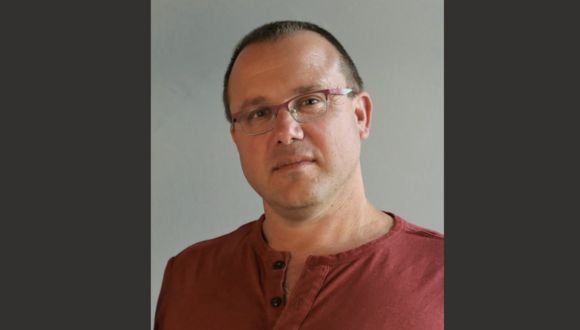
Prof. Ran Barkai.