
Recipe for a Strong Jewish People


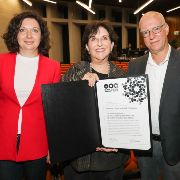
“Today, schools must expand Holocaust education. It must be about who the Jewish people really are, about our values and contributions, about the arc of Jewish history and why it’s in everyone’s interests to fight antisemitism,” says Dr. Anita Friedman, Vice Chairperson of the TAU Board of Governors, Chair of the recently-launched Comprehensive Campaign, and 2024 TAU Honorary Doctor.
Dr. Friedman lives by these words. She has dedicated her life to strengthening the Jewish community in the US and Israel. Her impact is felt throughout the Jewish world through a multitude of leadership positions in various education and community-support efforts, including Executive Director of Jewish Family and Children’s Services in California and President of the Koret Foundation.
Learning from History
Raised by Holocaust survivors, Dr. Friedman was shown from a young age the importance of both a strong Jewish community and of consistently standing up for an equitable society. Her mother’s story illustrates why: her family had to flee their small Polish town when antisemitic violence flared up there and around Poland–after the Holocaust had ended. Dr. Friedman and her children spent over ten years documenting and compiling the stories of two witnesses into a unique and moving documentary, Among Neighbors, which was released amid Poland’s own governmental attempt to hide its history of antisemitism.
The film has won awards at multiple film festivals in both the US and Poland and has drawn large audiences at theaters in Israel and the US. This included a special screening with a packed hall at Tel Aviv University’s 2025 Board of Governors meeting.
But Among Neighbors is not only intended for theaters; it is also meant for classrooms. The film is part of a wider effort to expand and rethink Holocaust education during a moment of rising antisemitism and social division in the US and globally. Dr. Friedman has already helped institute a state-funded grade school curriculum in California on injustice and the Holocaust, a collaboration between the Jewish community and 14 other marginalized groups. The program teaches both the specific story of the Holocaust and in general what can happen when a society discriminates against minorities. She also participated in the creation of a resource website for teachers, who report wanting more guidance for teaching this subject.
“Research shows that this type of programming increases empathy, reduces stereotyping, and creates young people who are willing to stand up against hatred,” she says. “The real fight is not on college campuses, it’s in K-12 education.”
Fortifying the Israel-Diaspora Bond
Youth education is just one facet of Dr. Friedman’s vision for a strong and connected Jewish people. Another is a robust relationship between diaspora and Israeli Jewry. She is strengthening this facet through the Koret Center for Jewish Civilization at Tel Aviv University, supported by the Koret Foundation. The Center, in partnership with the ANU Museum of the Jewish People, promotes dialogue across the Jewish world through educational initiatives and academic collaborations.
“Especially since October 7th, it's become clear that there is an important relationship between Israel and the diaspora that must be safeguarded. TAU is perfectly primed to provide leadership in this area, as it excels in both education of students and academic research. Through the Koret Center, we wanted to also strengthen Tel Aviv University as a force for good in the Jewish community.”
Caring for the World
Dr. Friedman understands, however, that the role of the Jewish people extends beyond its own borders. A strong Jewish people must follow through on its promise of tikkun olam–improving the world–and taking care of all people. “If we don’t practice what we preach, how does our ethical promise have any authenticity? It is vital to demonstrate what authentic Jewish community looks like when we put our principles into action.”
Through Jewish Family and Children’s Services, she is demonstrating this very effectively. The mental health and social services organization serves 150,000 people a year from various disadvantaged groups around the San Francisco Bay Area. With both volunteer and professional efforts, JFCS offers support to those in crisis and those facing daily challenges such as disability, grief, poverty and much more.
Thanks to these many ongoing projects, Dr. Friedman is optimistic in the face of difficult times for Jews: “Now it's up to us as Jewish leaders to inspire people to want to be involved, and to give them ways to be involved meaningfully. I feel major institutions like TAU are demonstrating this and standing as an extraordinary example of everything the Jewish people are proud of. All things considered, I am optimistic about the future of the Jewish people.”
Related Articles