
TAU participates in international space project
New space vehicle, 'Gaia', expected to revolutionize our understanding of the galaxy


On December 19, astronomers launched into space a new vehicle, named Gaia, which is expected to bring about a “revolution in the understanding of our galaxy.” Gaia will carry a telescope and other equipment that will map with unprecedented accuracy more than a billion stars and receive a 3-D map of the Milky Way, the galaxy in which Earth is located. The space vehicle was built by the European Space Agency at a cost of more than two billion euros.
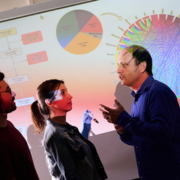
Prof. Shay Zucker, from Tel Aviv University's Department of Geophysics, Atmospheric and Planetary Sciences, along with his colleagues will analyze data collected from the unmanned space ship. Prof. Zucker says that “the data that it will send back to Earth will be as accurate as determining the location from Earth of a grain of sand on the Moon with a millimeter’s accuracy.”
According to Prof. Zucker, the colossal amount of data that will be gathered is expected to garner new insights into the creation and development of the Milky Way, shedding light on the past several billion years of its history.
A billion stars in a billion pixels
Gaia is expected to discover hundreds of thousands of planets that revolve around other planets, survey asteroids in our solar system and provide other fascinating and useful information about the nature of space. The space vehicle was built over a decade, and was launched using a Russian Soyuz missile from the launching pad of the European Space Agency in French Guiana. After it reaches its permanent orbit, Gaia will require several months to operate its delicate equipment. Gaia’s mission will continue for five years, during which it will document the location, clarity and temperature of every celestial body that passes its visual field, including a billion stars.
Gaia’s “camera” contains more than a billion pixels making it exceedingly accurate up to 10 microseconds. After its work is completed, an exact 3-D map will help scientists answer questions related to the origin of the Milky Way, Prof. Zucker says.
Like Earth, Gaia will revolve around the Sun once a year. Like 3-D vision using two eyes, the measurement of each star from a somewhat different location over the year will make it possible to measure depth, that is, the distance from Earth. This unprecedented accuracy will provide new ways of examining the veracity of Albert Einstein’s General Relativity Equations, using more accurate measurements of the movement of celestial bodies in the solar system that are close to us. These measurements, together with the movement of stars in the galaxy, are also expected to provide information on the nature of dark matter.
Related Articles