How Does Global Warming Impact Fish Abundance?




Research
How Does Global Warming Impact Fish Abundance?
An extensive international study led by researchers from Tel Aviv University found a decline in the abundance of marine fish species that rapidly move toward the poles to escape rising sea temperatures. The researchers explain that many animal species are currently moving toward cooler regions as a result of global warming, but the velocity of such range shifts varies immensely for different species. Examining thousands of populations from almost 150 fish species, the researchers show that contrary to the prevailing view, rapid range shifts coincide with widescale population declines. According to the study, on average, a poleward shift of 17km per year may result in a decline of 50% in the abundance of populations.
The international study was led by Ph.D. student Shahar Chaikin and Prof. Jonathan Belmaker from the School of Zoology in the Wise Faculty of Life Sciences and the Steinhardt Museum of Natural History at Tel Aviv University. The paper was published in the leading scientific journal Nature Ecology & Evolution.
For the first time, the new study correlated two global databases: (1) a database that tracks fish population size over time, and (2) a database that compiles range shift velocities among marine fishes. Altogether, 2,572 fish populations belonging to 146 species were studied, mostly from the Atlantic and Pacific Oceans in the Northern Hemisphere.

Left to right - Prof. Jonathan Belmaker and Shahar Chaikin
Prof. Belmaker explains: "We know that climate change causes animal species to move – northward, southward, upwards, or downwards – according to their location relative to cooler regions. In the mountains they climb upwards, in the oceans they dive deeper, in the Southern Hemisphere they move south toward Antarctica, and in the Northern Hemisphere, they move north toward the North Pole. In the present study we wanted to see what happens to species that move from one place to another: do they benefit by increased survivability, or are they in fact harmed by the shift – which was initially caused by greater vulnerability to climate change? We found that the faster fish shift toward the poles, the faster their abundance declines. Apparently, it is difficult for these populations to adapt to their new surroundings".
PhD student Chaikin: "We found that species shifting their geographical range more rapidly towards the poles, are in fact more likely to lose their abundance (e.g. European seabass). Additional findings show differences between populations that are closer to or further from the poles - within the geographical range of a particular species. While it might have been assumed that populations closer to the cooler polar margins of the species range would be less affected by climate change, we found that the opposite is true: fast poleward range shifts of populations from higher latitudes resulted in a more rapid decline in abundance compared to equatorial populations of the same species".
The researchers highlight that the new findings can and should guide environmental decisionmakers, by enabling a reevaluation of the conservation status of various species and populations. The study's results suggest that populations exhibiting rapid poleward range shifts require close monitoring and careful management. Thus, for example, pressures that threaten their survival can be mitigated through measures like fishing limits.
Prof. Belmaker: "The common belief is that rapid range shifts safeguard a species against local population decline. But in this study, we found that the opposite is true. Apparently, species rapidly shifting their range in search of cooler temperatures do so because they are more vulnerable to climate change, and consequently require special attention. Last year we published another study that focused on local fish species along Israel's coastline, which resulted in similar findings: species that move towards deeper and cooler habitats in the face of rising water temperatures exhibit declining populations. In the next stage of our research, we intend to investigate this causal relationship in additional marine species, other than fish".

Research
Grass Is Greener, Lives Are Longer: Nature's Impact on Heart Patients' Health
In a long-term study, unprecedented in its kind and scope, researchers from Tel Aviv University examined the association between a greener environment, which is most likely saturated with vegetation, and the mortality rate of coronary heart patients after undergoing bypass surgery – which is considered a traumatic event from both the physical and mental aspects. The study, which was carried out on thousands of patients who live all over the State of Israel and followed them over more than 10 years, found that the survival rate of bypass surgery heart patients who live in greener areas is significantly greater than those whose living environment is devoid of greenery.
The study was conducted by Ph.D. student Maya Sadeh under the guidance of Prof. Rachel Dankner from the Department of Epidemiology and Preventive Medicine at the School of Public Health in the Faculty of Medical and Health Sciences and Prof. Alexandra Chudnovsky from the Porter School of Environment and Earth Sciences at TAU. Also participating: Nir Fulman, also from the Porter School, Nirit Agay and Arnona Ziv from the Gertner Institute for Epidemiology Research at Sheba Medical Center, Ilan Levy from the Ministry of Environmental Protection, and Prof. Michael Brauer from the University of British Columbia in Canada. The research was carried out with the support of the Environment and Health Fund and the Israel Science Foundation and was published in the prestigious journal Epidemiology.
Prof. Dankner: “The current study was based on a database we built at the Gertner Institute about 20 years ago for another study: 3,128 heart patients who underwent bypass surgery in seven medical centers in Israel, from Haifa to Beer Sheva, between the years 2004-2007. Using data from the Ministry of the Interior Affairs we found that 1,442 (46%) of them died of various causes by the year 2021. In this study, we wanted to examine to what extent (if at all) the life expectancy of heart patients after surgery is associated with the amount of green vegetation in their residential area”.
For the study, the researchers cross-referenced the patients’ residential address data with data from NASA’s Landsat satellites, which photograph the Earth and can locate the color green with a very high resolution and within a range of up to 30x30 meters from the residential address – which allows identification of vegetation even within urban areas.
The researchers worked to accurately account for the amount of greenery in a radius of up to 300m around the address of each patient and placed this figure against the dates of death or survival of the patients over 14 years from the date of surgery. They performed a detailed statistical analysis of the data, including adjustments for a variety of variables, such as age, sex, ethnicity, socioeconomic status, urgency of the hospitalization (elective, semi-elective, or emergency surgery), living in the periphery/center, air pollution, and living distance from the Mediterranean Sea. About 90% of the research participants lived in urban areas, 80% in the coastal plain from the center to Haifa, 15% in the Jerusalem area, and 5% in the southern Beer Sheva area.
Maya Sadeh: “We divided the residential addresses of the patients into three groups, according to the amount of vegetation in their surroundings, and found a clear significant association between a green environment and the survival of the patients – that is, how many years they continued to live after the operation. The results revealed that during the mean time of 12 years following the operation, the risk of mortality for those who lived in a very green environment was lower on average by 7% compared to those who lived in a non-green environment. We also found that the beneficial relationship is more pronounced among women, who made up 23% of the cohort, and were older at the time of the surgery (69.5 years old on average) compared to men (63.8 years )".
The researchers conclude: "In this study, we examined the survival of coronary heart patients after undergoing bypass surgery, and found that living in a greener environment is associated with better chances of survival. We hypothesize that there are a variety of reasons for this: in a green environment, people breathe cleaner air and engage in more physical activity, the atmosphere may be calmer, and the quality of life is better overall. The research findings may be particularly relevant to the current period in Israel: implying that exposure to a green environment may be a beneficial factor in recovering from trauma".

Research
A trauma-focused course offers support and extra training to social workers treating Oct. 7 survivors
Nearly everyone across Israel has been affected by the brutalities of October 7, whether directly or indirectly. Social workers, though very experienced working with traumatized and disadvantaged populations, found themselves overwhelmed in the face of such monumental horror. To help social workers provide the best service while also protecting their own mental health, Tel Aviv University’s Bob Shapell School of Social Work initiated a six-week online course for working with acute trauma and PTSD.
The course is now in its fifth round, but is still having trouble keeping up with demand. “When we first published the course, 10 times more people than we had space for signed up,” says Dr. Julia Gouzman, the course organizer. "There is a pressing need for this resource, which has received philanthropic support from the Jewish United Fund of Metropolitan Chicago. Additionally, thanks to the generous support of Chevron Mediterranean Limited, 5 more rounds of the course will begin in the very near future."
Uncharted Waters of Oct. 7 Trauma
The idea for a training program came from the numerous testimonies of social workers feeling unprepared for the magnitude of the crisis. Some did not work with trauma victims before the Israel-Hamas war, while those that had felt the tools and models they’d used previously were not adequate to address the specific needs and hardships they were now treating.
“During this time, a lot of us were winging it in our work, since there was simply no way to prepare for what we were facing. Much of what we did was based mainly on intuition,” explains Tal Magal, a course graduate who has been working with evacuees from the Gaza border at a hotel since the beginning of the war. She has been a social worker for about 22 years and works with at-risk children.
Tal Magal: “Though I work with trauma regularly, in this case I felt like I needed some kind of anchor to get my mind in order.”
Kelly Ashwal, another course participant, also describes how emotionally demanding those first weeks were. Ashwal works at Beilinson Hospital, which treated direct survivors of the Oct. 7 attack including soldiers and Nova partygoers. “We started getting in helicopter after helicopter of people. Those first visits with the injured were so hard—I felt it in my body, horrible headaches and stomach aches.” She describes how she had to walk many people through the shock of grief and severe panic attacks. There are also Holocaust survivors in long-term care at the hospital whom she helped through flashbacks brought on by news of the violence.
“We all had lots of questions about how best to approach those affected,” says Ashwal. “I was trying my best to handle each individual case properly, so when I saw the ad for the TAU course, I thought it sounded perfect for my needs.”
Both women recount how glad they were to receive news that a course was opening. Magal: “Though I work with trauma regularly, in this case I felt like I needed some kind of anchor to get my mind in order.”
Anchoring in Tools and Methods
The course’s main foci include emergency trauma treatments, long-term PTSD prevention, resilience and growth, trauma in children, and self-preservation for social workers themselves. After each class, the participants receive the materials so they can revisit them at any time.
Says Magal, “The fact that the course was structured for those like me in the thick of things was the reason I was able to attend. It was on Zoom, it wasn’t a huge time commitment, and it didn’t require extra preparation. It let me continue with my work at the hotel and in my regular work. That’s so important because time is precious right now. There were a couple times I attended from right at the hotel--I felt the information was so important I couldn’t miss it.”
Both Ashwal and Magal say the course gave them solid ground to stand on. “We learned breathing exercises and how to ground ourselves in our physical space,” says Ashwal. “I use that all the time now both for myself and my patients. I received tools I didn’t have for helping parents speak with their kids, as well as for emotionally protecting myself. Though the work still affects me, with the help of the course I feel much more capable of doing my job.”
Kelly Ashwal: "Though the work still affects me, with the help of the course I feel much more capable of doing my job.”
Magal adds that the program sharpened the tools she had and gave her confidence in her methods. It also gave her the ability to help patients out of the trauma mindset so they can start looking forward to the future and taking control of their lives.
Says Chair of the Shapell School’s Unit for Continuing Education and Training, Dr. Lia Levin: “Making available basic tools for working with trauma is of utmost importance for the resilience of all the country's residents. At the same time, it is also the realization of basic values that guide us at Tel Aviv University--uncompromising professionalism and contribution to the community."
With four course cycles completed, the program has received high praise from participants. “We’ve had many requests to open a follow-up program to deepen and expand the subject matter,” says Dr. Gouzman. "I am very proud to be at the head of a program that meets such a huge need. I am constantly moved by the feedback from participants.”
Dr. Julia Gouzman: "I am very proud to be at the head of a program that meets such a huge need. I am constantly moved by the feedback from participants.”
Magal says, “I have no doubt that I’ll continue to use what I learned in the course even after all of this ends, both because I work with trauma day to day, but also because in Israel there’s always a risk of other disasters. Israeli social workers will be better off when they’re equipped to help out immediately when they are needed. We need this knowledge because Israel is our home, and this is the reality we face.”

Research
Gender and Law Professor Daphna Hacker speaks on women, war, and her experience at the UN
One devastating aspect of the current war has been the world’s hesitance to speak up about the gendered violence which took place on October 7th. TAU’s own Prof. Daphna Hacker is a member of the United Nations Committee on the Elimination of All Forms of Discrimination Against Women (CEDAW) and was in Geneva when the war began. Prof. Hacker teaches and researches Law and Gender at the Buchmann Faculty of Law and Entin Faculty of Humanities and is one of Israel’s foremost experts on gender. TAU sat down with her to hear her perspectives on working at the UN, its response to the current war, and the gendered aspects of warfare.
Please be advised this interview contains discussion of heavy topics including gendered and antisemitic violence.
How has your experience at CEDAW been so far, especially as an Israeli?
We’re 23 people, right now 22 women and one man. It's the most diverse, strongly feminist group that I've ever been part of. The first year was really exciting and I was so impressed by everyone’s professionalism.
But the last session I attended was just after October 7th, and that was rough and disappointing. They decided to issue a statement. Even though protocol is for members not to be involved in decisions about their home countries, they asked me at a certain point to gather information especially about the sexual violence. In the end they issued this half-page, horribly embarrassing statement that didn't even say “Hamas” once. I have to admit, I was really surprised by the outcome. Until then I didn't feel that this was a terribly politicized committee, but I discovered there were underlying political motives that I hadn’t noticed before. It was really a challenge, especially being far from home at such a time.
I did not attend the following session that took place in February to give myself space from that experience and to be with my students. In May, though, I’ll have to go back and face them again.
Can you elaborate on the attitude toward Israel and the Jewish people at the UN?
Placing what happened in CEDAW in broader context of the reaction of feminist organizations, of UN organizations, of left-wing organizations in the States and other Western countries, it seems that for many, it is very hard to perceive Israel as the victim. Israel is a flourishing country with an allegedly strong army. So people are not able to recognize that this time we were facing a murderous terrorist organization that did atrocities. There is simply so much ignorance and disinformation.
"I didn't feel until now that being Israeli at the UN was an issue - on the contrary, Israel is known to be very good on gender equality and our experts are well-respected."
Beyond that, I did see instances of antisemitism at the UN, for example comments about Jews and money that no one blinked at. However I didn't feel until now that being Israeli was actually an issue - on the contrary, Israel is known to be very good on gender equality and our experts are well-respected. I am actually the fourth Israeli that has held a UN position on gender.
When you wear the gender lens, you can’t help but see how so many things are tied to gender. This is an extraordinary war when it comes to gender, on multiple fronts. This is the first time that we have female combat soldiers taking such a prominent role. We had the all-female tank crews that saved kibbutzim. It's also the first time the Israeli public has been exposed to women in Gaza as combat soldiers and doctors, and everyone seems to be okay with it. But on the flip side we have the Tatzpitaniot (female soldiers who keep watch over the border fence through cameras) saying they had warned the army about Hamas for months and nobody listened.
And then we have the sexual violence on October 7. Never in Israeli history was the enemy for eight hours or more in civilian villages, free to do whatever they want. And of course, the hostages. Never in Israeli history have tens of women been taken.
What are some ways the current war is affecting different genders differently?
One glaring gender issue was that women and children were the first hostages released. Because the Red Cross was not allowed by Hamas to see them, we didn't know who should have been released first based on their medical condition. In a more humane version of this horribly inhumane situation, we would know who needs assistance, and it shouldn't matter if they were a man or a woman. But Hamas will not even allow this very minimal gesture.
Another issue is that when it comes to the war effort, there is no doubt that men bear the brunt of hardship. Combat soldiers are still majority male. Being in Gaza and risking their lives, and killing others, for weeks on end—we know the rates of PTSD, they are extremely high. At the same time, men are a majority at the policy- and peacemaking tables.
"While gender is an important angle, we need to remember to acknowledge our common suffering as well."
But I actually feel that while gender is an important angle, we need to remember to acknowledge our common suffering as well. Talking only about “women and children” is detrimental for the future if we want a world in which we can pursue our biographies regardless of what body we were born in.
International law has recognized rape as a weapon of war, as something done by an enemy against a nation. So, we know it is not a coincidence that Hamas raped and violated women. This was not one terrorist doing his horrible thing. Unfortunately documentation is so complicated because in all of the chaos, Israeli authorities did not gather forensic evidence of sexual violence in the moment. There was no precedent; we have no prior experience of war-related sexual violence on Israeli land.
International bodies were in theory trying to be cautious about accuracy. But to not even condemn Hamas, and to leave out the gendered violence as part of a long list of undeniable atrocities in those first few weeks -- to me, this is simply cruel antisemitism and anti-Israelism. We did more recently have a week-long visit by the UN Special Representative on Sexual Violence in Conflict Pramila Patten. She listened and learned, and she has just submitted her report unequivocally acknowledging that sexual assaults were committed on October 7. That was a big accomplishment of Israeli feminists who insisted on her visit.
Can you tell me a bit about your academic background? How long have you been at TAU, and what are your main research topics? How did you come to the gender studies field?
My first degree was in Law, and at the time we barely had Women’s Studies in Israeli academia. It only came onto my radar because I heard a lecture about feminism. That hour and a half changed my life. It was mind-blowing as a young woman to put words to so many things I had experienced.
"Women's studies only came onto my radar because I happened to hear a lecture about feminism. It was mind-blowing as a young woman to put words to so many things I had experienced."
After earning an MA in human rights law in the US, I arrived at TAU to do a PhD in Sociology. At that point I felt I’d found my intellectual home in the field of law and society. I specialize in feminist jurisprudence, family law and the sociology of family.
What was the process of being appointed to CEDAW?
I have been committed to activism all my life. I was one of the founding members of “Women Lawyers for Social Justice” in Israel, and sat on other boards and committees for women’s equality. I always dreamed of taking my activism global by becoming a CEDAW member. Then one day, all of a sudden, the Ministry of Foreign Affairs called me up about just that! It felt like they’d read my mind.
The process took a whole year. We made a video of me, and I went to New York to meet election officers who interviewed me about my goals for the committee. In the end 115 countries voted for me.
How does CEDAW operate?
When a country ratifies an international convention, it takes upon itself the obligation to report to the relevant committee every few years. CEDAW’s main responsibility is to review reports regarding women’s rights from governments and NGOs on the ground. Countries send delegations of diplomats whom we question; we then write our own report with suggestions for the country. We are also authorized to hear individual complaints against governments who have authorized it. Of course, because participation is voluntary, CEDAW cannot enforce its recommendations. All we can do is hope a country cares about human rights enough, or is worried enough about international shaming, to listen to us. One accomplishment recently was our recommendation to Bahrain to change a law allowing a rapist to escape criminal charges by marrying his victim. Two weeks later they changed the law!
Has your participation in the committee affected your views?
I’ve really learned the value of diplomacy and meeting countries and governments where they are. We are forging dialogues with these countries instead of imposing opinions that are totally foreign to certain cultures or are economically unrealistic.
"The fact that women in disadvantaged or more oppressive countries may be able to access our livestreamed hearings and see that we try to hold their governments accountable can help offer empowerment."
Additionally, although I was aware of some of the harshest conditions for women in certain countries, learning about them so thoroughly has both helped me internalize and understand the importance of committees like CEDAW, whose sessions are livestreamed. We’ve spoken with African countries with high rates of child marriage and extremely low access to birth control, as well as China where there is very little free speech, and the fact that women in those countries may be able to access our hearings and see that we try to hold their governments accountable can help offer empowerment.
Have there been any surprising discoveries about how the UN works?
It turns out the UN is in a horrible state financially to a degree that makes working difficult. This is partially because the prosperous countries who fund the UN do not want a strong treaty body to supervise human rights violations. When you have powerful countries that invade other countries (some of whom have blocked UN recognition of Hamas as a terrorist organization), that silence opposition, that call themselves democracies although they're not, the whole world suffers. Economically weakening the apparatus that was built to prevent a third world war is one way to get away with human rights violations.
So again, we can be cynical and think we shouldn’t bother with these international efforts, but at the same time, we can't do without them. Forsaking our global connections when Israel is so small and in a hostile neighborhood can’t end well, and we’ve seen this with other countries too.
Are you still doing research during these tough times?
Honestly, I feel that my research is what saved my sanity. Clinging to normalcy while making space for activism is so important for our mental health, and being at TAU has been a blessing. I get to meet smart and well-spoken students, and to pursue my intellectual interests. We are a tiny gender studies department, which is a bit of a challenge, but I feel I have everything I could ask for from a job here.
"I feel that my research is what saved my sanity. Clinging to normalcy while making space for activism is so important for our mental health, and being at TAU has been a blessing."
That being said, I have not only been able to concentrate on my work in these difficult times: in an effort to expand knowledge of Middle East history and politics as well as paths forward, two colleagues and I created a “Day After the War” Forum. The Forum’s goal is to raise awareness in the Israeli public that overthrowing Hamas must be part of a broader multi-state political alliance with cooperative Western countries and moderate Arab countries. We hold public webinars from experts on Middle Eastern studies and conflict resolution, among other things. (The Hebrew site can be seen here.) Learning from these sessions has given me some hope for the future.

Research
Bacteria-Targeting Viruses Adapt, Improving their Decision-Making
Researchers from the Shmunis School of Biomedicine and Cancer Research at Tel Aviv University have deciphered a novel complex decision-making process that helps viruses choose to turn nasty or stay friendly to their bacterial host. In a new paper, they describe how viruses co-opt a bacterial immune system, intended to combat viruses like themselves, in this decision-making process. The study was led by Polina Guler, a PhD student in Prof. Avigdor Eldar's lab, in addition to other lab members, at the Shmunis School of Biomedicine and Cancer Research, George S. Wise Faculty of Life Sciences. The paper was published in Nature Microbiology.
Bacteriophages, also known as phages, are types of viruses that infect bacteria and use the infected bacteria to replicate and spread. Even though the word 'bacteriophage,' meaning 'bacteria devouring' in ancient Greek, suggests destruction, many phages can adopt a "sleeping" mode, in which the virus incorporates itself into the bacterial genome. In fact, in this mode of action, the virus can even have a symbiotic relationship with the bacteria, and its genes can help its host prosper.
In general, Eldar explains that phages usually prefer to stay in the “sleeping”, dormant mode, in which the bacteria "cares" for their needs and helps them safely replicate. Previous research published by the Eldar lab has shown that the phages' decision-making uses two kinds of information to decide whether to stay dormant or turn violent: the "health status" of their host and signals from outside indicating the presence of other phages around.
"A phage can't infect a cell already occupied by another phage. If the phage identifies that its host is compromised but also receives signals indicating the presence of other phages in the area, it opts to remain with its current host, hoping for recovery. If there is no outside signal, the phage 'understands' that there might be room for it in another host nearby and it’ll turn violent, replicate quickly, kill the host, and move on to the next target", Eldar explains.
The new study deciphers the mechanism that enables the virus to make these decisions. "We discovered that in this process the phage actually uses a system that the bacteria developed to kill phages", says Guler. If it does not sense a signal from other phages—indicating that it has a good chance of finding new hosts—the phage activates a mechanism that disables the defense system. "The phage switches to its violent mode, and with the defense system neutralized, it is able to replicate and kill its host", describes Guler. "If the phage senses high concentrations of the signal, instead of disabling the defense system, it utilizes its defense activity in order to turn on its dormant mode".
"The research revealed a new level of sophistication in this arms race between bacteria and viruses," adds Eldar. Most bacterial defense systems against phages were studied in the context of viruses that are always violent. Far less is known about the mechanisms of attacks and interaction with viruses that have a dormant mode. "The bacteria also have an interest in keeping the virus in the dormant mode, first and foremost to prevent their own death, and also because the genes of the dormant phage might even contribute to bacterial functions," says Eldar.
“This finding is important for several reasons. One reason is that some bacteria, such as those causing the cholera disease in humans, become more violent if they carry dormant phages inside them - the main toxins that harm us are actually encoded by the phage genome," explains Eldar. “Another reason is that phages can potentially serve as replacements to antibiotics against pathogenic bacteria. Finally, phage research may lead to better understanding of viruses in general and many human-infecting viruses can also alternate between dormant and violent modes”.

Research
Pendulum Experiment Sheds Light on Quantum Mysteries in Topological Materials, Revealing Insights Unreachable by Traditional Methods
A recent study conducted at Tel Aviv University has devised a large mechanical system that operates under dynamical rules akin to those found in quantum systems. The dynamics of quantum systems, composed of microscopic particles like atoms or electrons, are notoriously difficult, if not impossible, to observe directly. However, this new system allows researchers to visualize phenomena occurring in specialized “topological” materials through the movement of a system of coupled pendula.
The research is a collaboration between Dr. Izhar Neder of the Soreq Nuclear Research Center, Chaviva Sirote-Katz of the Department of Biomedical Engineering, Dr. Meital Geva and Prof. Yair Shokef of the School of Mechanical Engineering, and Prof. Yoav Lahini and Prof. Roni Ilan of the School of Physics and Astronomy at Tel Aviv University and was recently published in the Proceedings of the National Academy of Sciences of the USA (PNAS).
Exploring Quantum Wave Phenomena
Quantum mechanics governs the microscopic world of electrons, atoms and molecules. An electron, which is a particle that moves in an atom or in a solid, may have properties that give rise to wave-like phenomena. For instance, it may demonstrate a probability of dispersing in space similar to waves spreading out in a pool after a stone is thrown in, or the capability to exist simultaneously in more than one place.
Such wave-like properties lead to a unique phenomenon that appears in some solid isolators, where even though there is no electric current through them, and the electrons do not move due to an external electric voltage, the internal arrangement of the material shows up in a state referred to as “topological”. This means that the wave of electrons possesses a quantity that can “close on itself” in different ways, somewhat like the difference between a cylinder and a Möbius strip. This “topological” state of the electrons, for which the 2016 Nobel Prize in Physics was awarded, is considered a new state of matter and attracts much current research.
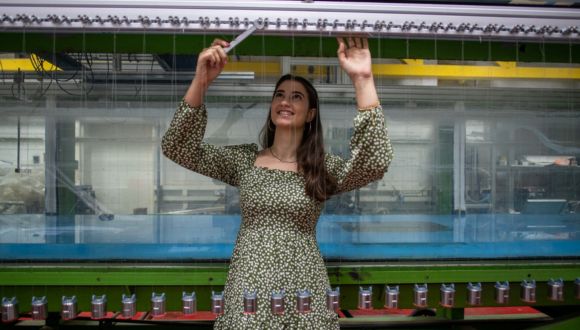
Chaviva Sirote-Katz
Despite the theoretical interest, there is a limitation in measuring these phenomena in quantum systems. Due to the nature of quantum mechanics, one cannot directly measure the electron’s wave function and its dynamical evolution. Instead, researchers indirectly measure the wave-like and topological properties of electrons in materials, for instance by measuring the electrical conductivity at the edges of solids.
In the current study, the researchers considered the possibility of constructing a sufficiently large mechanical system that would adhere to dynamical rules akin to those found in quantum systems, and in which they could directly measure everything. To this end, they built an array of 50 pendula, with string lengths that slightly varied from one pendulum to the other. The strings of each neighboring pair of pendula were connected at a controlled height, such that each one’s motion would affect its neighbors’ motion.
Quantum Pendulum Insights
On one hand, the system obeyed Newton’s laws of motion, which govern the physics of our everyday lives, but the precise lengths of the pendula and the connections between them created a magical phenomenon: Newton’s laws caused the wave of the pendulum’s motion to approximately obey Schrödinger’s equation – the fundamental equation of quantum mechanics, which governs the motion of electrons in atoms and in solids. Therefore, the motion of the pendula, which is visible in the macroscopic world, reproduced the behaviors of electrons in periodic systems such as crystals.
The researchers pushed a few pendula and then released them. This generated a wave that propagated freely along the chain of pendula, and the researchers could directly measure the evolution of this wave – an impossible mission for the motion of electrons. This enabled the direct measurement of three phenomena. The first phenomenon, known as Bloch oscillations, occurs when electrons within a crystal are influenced by an electric voltage, pulling them in a specific direction. In contrast to what one would expect, the electrons do not simply move along the direction of the field, but they oscillate back and forth due to the periodic structure of the crystal. This phenomenon is predicted to appear in ultra-clean solids, which are very hard to find in nature. In the pendula system, the wave periodically moved back and forth, exactly according to Bloch’s prediction.
The second phenomenon that was directly measured in the pendula system is called Zener tunneling. Tunneling is a unique quantum phenomenon, which allows particles to pass through barriers, in contrast to classical intuition. For Zener tunneling, this appears as the splitting of a wave, the two parts of which then move in opposite directions. One part of the wave returns as in Bloch oscillations, while the other part “tunnels” through a forbidden state and proceeds in its propagation. This splitting, and specifically its connection to the motion of the wave in either direction, is a clear characteristic of the Schrödinger equation.
In fact, such a phenomenon is what disturbed Schrödinger, and is the main reason for the suggestion of his famous paradox; according to Schrödinger’s equation, the wave of an entire cat can split between a live-cat state and a dead-cat state. The researchers analyzed the pendula motion and extracted the parameters of the dynamics, for instance, the ratio between the amplitudes of the two parts of the split wave, which is equivalent to the quantum Zener tunneling probability. The experimental results showed fantastic agreement with the predictions of Schrödinger’s equation.
The pendula system is governed by classical physics. Therefore, it cannot mimic the full richness of quantum systems. For instance, in quantum systems, the measurement can influence the system’s behavior (and cause Schrödinger’s cat to eventually be dead or alive when it is viewed). In the classical system of macroscopic pendulum, there is no counterpart to this phenomenon. However, even with these limitations, the pendula array allows the observation of interesting and non-trivial properties of quantum systems, which may not be directly measured in the latter.

The third phenomenon that was directly observed in the pendula experiment was the wave evolution in a topological medium. Here, the researchers found a way to directly measure the topological characteristic from the wave dynamics in the system – a task that is almost impossible in quantum materials. To this end, the pendula array was tuned twice, so that they would mimic Schrödinger’s equation of the electrons, once in a topological state and once in a trivial (i.e. standard) state. By comparing small differences in the pendulum motion between the two experiments, the researchers could classify the two states. The classification required a very delicate measurement of a difference between the two experiments of exactly half a period of oscillation of a single pendulum after 400 full oscillations that lasted 12 minutes. This small difference was found to be consistent with the theoretical prediction.
The experiment opens the door to realizing further situations that are even more interesting and complex, like the effects of noise and impurities, or how energy leakage affects wave dynamics in Schrödinger’s equation. These are effects that can be easily realized and seen in this system, by deliberately perturbing the pendula motion in a controlled manner.