Elephant Hunting and Stone Quarries in the Paleolithic Era




Research
Early humans in Israel's Hula Valley invested in systematic procurement of raw materials hundreds of thousands of years ago – much earlier than previously assumed
A new study from Tel Aviv University and Tel-Hai College solves an old mystery: Where did early humans in the Hula Valley, in northern Israel, get flint to make the prehistoric tools known as hand axes? The researchers applied advanced methods of chemical analysis and AI to identify the geochemical fingerprints of hand axes from the Hula Valley's oldest prehistoric sites, Ma'ayan Barukh and Gesher Benot Ya'aqov. Their findings indicate that the raw material came from exposures of high-quality flint in the Dishon Plateau, about 20km to the west, and hundreds of meters above the Hula Valley. The researchers: "Our findings indicate that these early humans had high social and cognitive abilities: they were familiar with their surroundings, knew the available resources, and made great efforts to procure the high-quality raw materials they needed. For this purpose, they planned and carried out long journeys, and transferred this essential knowledge to subsequent generations."
"Our findings indicate that early humans were highly capable: they planned and implemented complex strategies and passed on essential information from one generation to the next." - The researchers
The study was led by Dr. Meir Finkel of the Department of Archaeology and Ancient Near East Cultures, Tel Aviv University and Prof. Gonen Sharon of the MA Program in Galilee Studies, Tel-Hai College, in collaboration with Prof. Erez Ben-Yosef, Tel Aviv University, Dr. Oded Bar and Dr. Yoav Ben Dor, the Geological Survey of Israel, and Ofir Tirosh, the Hebrew University. The paper was published in Geoarchaeology.
Dr. Finkel: "The Hula Valley, located along the Dead Sea Transform Rift, is well known for its many prehistoric sites, the oldest of which date back to 750,000 years before present (YBP). The valley offered early humans rich sources of water, vegetation, and game, right on the northward migration route from Africa - the Great African Rift Valley. These early inhabitants left behind them many artifacts, including thousands of hand axes – flint stones chiseled to fit the human hand. One of the earliest and most universal tools produced by humans, the hand axe may have served as a multipurpose 'penknife' for many different tasks, from cutting game meat to digging for water and extracting roots. It was used in many different parts of the Old World, in Africa, Asia, and Europe, for about 1.5 million years."
"One of the earliest and most universal tools produced by humans, the hand axe may have served as a multipurpose 'penknife' for many different tasks, from cutting game meat to digging for water and extracting roots." - Dr. Meir Finkel
In the present study the researchers looked for the source of the raw material used to produce thousands of hand axes found at two prehistoric sites in the Hula Valley: Gesher Benot Ya'aqov, dated to 750,000 YBP and Ma'ayan Barukh, dated to 500,000 YBP, both Acheulian. Prof. Sharon: "Approximately 3,500 hand axes were found scattered on the ground at Ma'ayan Barukh, and several thousands more were discovered at Gesher Benot Ya'aqov. The average hand axe, a little over 10cm long and weighing about 200g, was produced by reducing stones that are five times larger – at least 1kg of raw material. In other words, to make the 3,500 hand axes found at Ma'ayan Barukh alone, early humans needed 3.5 tons of flint. But where did they obtain such a huge amount of flint? Many researchers have tried to answer this question, but our study was the first to use innovative 21st century technologies: advanced chemical analysis and an AI algorithm developed specifically for this purpose."
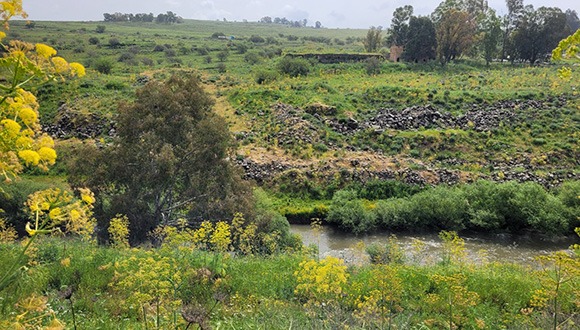
The Gesher Benot Ya'aqov area
The researchers took samples from 20 hand axes – 10 from Gesher Benot Ya'aqov and 10 from Ma'ayan Barukh, ground them into powder and dissolved the powder in acid in a clean lab. For each sample they measured the concentration of approximately 40 chemical elements, using an ICP-MS (inductively coupled plasma mass spectrometer), a state-of-the-art device that accurately measures the concentration of dozens of elements, down to a resolution of one particle per billion.
In addition, in order to locate possible flint sources available to the Hula Valley's prehistoric inhabitants, the researchers conducted a field survey covering flint exposures in the Safed Mountains, Ramim Ridge, Golan Heights, and Dishon Plateau, as well as cobbles from streams draining into the Hula Valley: the Jordan, Ayun, Dishon, Rosh Pina, and Mahanayeem. This methodical survey was combined with a comprehensive literature review led by Dr. Bar of the Geological Survey of Israel. Flint samples collected from all potential sources were then analyzed using ICP-MS technology to enable comparison with the hand axes. A novel computational approach specially adapted by Dr. Ben Dor of the Geological Survey of Israel was used for this comparison.
Dr. Ben Dor: "The complex process, from collecting and preparing the samples to the chemical analysis, produced a very large amount of data for each sample. To enable optimal matching between data from the archaeological artifacts and data from the flint exposures, we developed a dedicated algorithm based on several computational steps, alongside machine learning models. Thus, we were able to classify the archaeological artifacts according to the database derived from the geological samples."
"To procure suitable raw materials for producing their vital hand axes, [humans living in the Hula Valley hundreds of thousands of years ago] planned and carried out 20km hikes that included an ascent from 70 to 800 meters above sea level." Prof. Erez Ben-Yosef
Dr. Finkel: "Through the computational process we discovered that all 20 archaeological artifacts were made of flint from a single source: the Dishon Plateau's flint exposures dating back to the Eocene geological epoch, about 20km west of the Gesher Benot Ya'aqov and Ma'ayan Barukh sites. At the Dishon Plateau we also found a prehistoric flint extraction and reduction complex, indicating that the place served as a flint source for hundreds of thousands of years. In addition, we demonstrated that cobbles from streams draining into the Hula Valley were too small to be used as raw material for hand axes, ruling out this possibility."
Kadar Family Award for Outstanding Research recipient Prof. Ben-Yosef: "Our findings clearly indicate that humans living in the Hula Valley hundreds of thousands of years ago, probably hominids of the homo erectus species, possessed high cognitive and social capabilities. To procure suitable raw materials for producing their vital hand axes, they planned and carried out 20km hikes that included an ascent from 70 to 800 meters above sea level. Moreover, they passed on this important knowledge from one generation to the next, over many millennia. All these suggest a high level of sophistication and ability, which modern researchers do not usually attribute to prehistoric humans from such an early period."

From left: Dr. Meir Finkel and Prof. Erez Ben-Yosef