
Bridging the Gap: TAU Students Assist an Impoverished Town
A hands-on course at the TAU Buchmann Faculty of Law brings legal knowledge to needy citizens


A low railing separates the distressed town of Jisr al-Zarqa from the affluent coastal city of Caesarea. Just a thin barrier, yet it represents a vast divide—socially, economically, and historically. Nestled along Israel’s Mediterranean coast, Jisr al-Zarqa is the country’s only Arab town on the shoreline, home to some 16,000 residents living on barely two square kilometres of land. Established in the 1920s around fishing and agriculture, the town today faces high unemployment, overcrowded housing, and decades of planning neglect.
Into this gap steps Tel Aviv University. Through its Buchmann Faculty of Law, the University is pioneering an educational initiative that merges legal education with social responsibility, societal change, and coexistence. The course, “Jisr al-Zarqa – Space, Planning, and Housing,” invites law students to bring the classroom to the community. Once a week, students visit Jisr al-Zarqa’s social services headquarters, offering pro bono legal advice on matters ranging from housing assistance and other governmental benefits to more complex legal matters, such as housing registration and permits.
“I enrolled in this course out of a deep sense of obligation, especially toward vulnerable groups or those who have experienced exclusion for various reasons,” says Bashar Siri, a third-year TAU law student.
"I’m glad I took part in the course to help, even if only in a small way. The residents here are an inseparable part of us.”
Hands-on Learning
Led by Prof.Neta Ziv, TAU’s Vice President for Equity, Diversity and Community, along with attorney Sharon Karni Kohn from the Hagar Carasso Social Housing Program, the course is a model of engaged scholarship.
“The Jisr al-Zarqa Housing and Planning course is unique in the way teaching and research are conducted at the law school,” explains Prof. Ziv.
“First, it brings together Arab and Jewish students in work settings to explore how law can improve the lives of people in the poorest locality in Israel—and at the same time, how law can be used by the powerful to reinforce inequality. Second, students go out into the field, applying their skills to assist real people in real situations while studying doctrine and legal theory. Finally, for Arab students, this is one of the few opportunities to study their own communities academically, with hands-on reflective practice.”
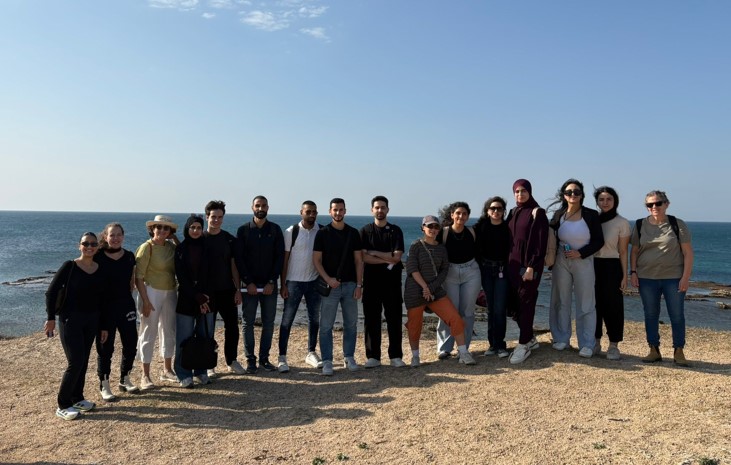
Jisr al-Zarqa Housing and Planning course students and professors
The TAU work is tangible and immediate. On a recent morning, Kohn helped a resident whose home had been recently demolished due to the absence of a building permit. Together, they filled out a rent-assistance form, a small but vital step toward stability.
Diving Deep
The course is supplemented by guest lectures from experts across multiple disciplines, including architect Areej Serhan, a planner who discussed the challenges of mobility and development in Arab communities. “Arab towns often suffer from a lack of proper paperwork, planning, and development,” she explained. “It becomes a vicious cycle that is not easy to break.” Yet, Serhan said, in recent years, the situation is changing. “There’s talk of advancing social mobility and cooperation. We see progress in closing gaps in educational results and economic growth in certain communities.”
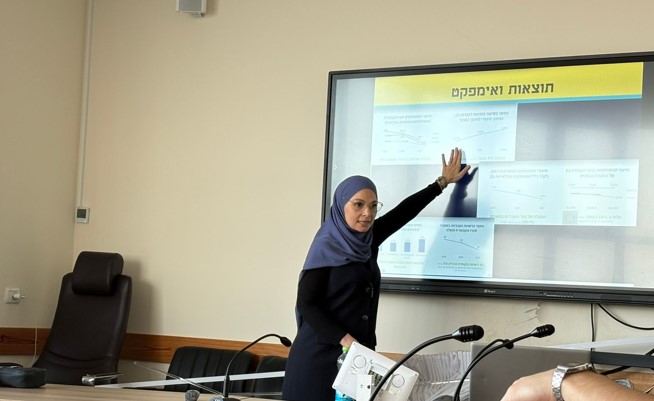
Architect Areej Serhan addressing the students
The TAU course is part of the change. Funded by the Social Initiative for the Implementation of Government Decision 1804 (through the JDC) and the Galileo Fund, and supported by TAU’s Commission for Equality and Diversity, the course exemplifies the University’s commitment to social impact. It bridges gaps—between communities, between students and society, and between legal knowledge and real-world application.
Related Articles