
From Brilliant Ideas to Better Lives


Every university produces discoveries. The harder challenge is what comes next: taking a promising idea out of the laboratory and giving it a chance to become a technology, a treatment, or a company that can make a real difference.
At Tel Aviv University, that challenge is at the heart of the Zimin Institute for Engineering Solutions Advancing Better Lives. Established in 2018 with the support of the Zimin Foundation, the Institute was created around a distinctive idea: identify research with exceptional scientific promise and a clear path toward practical application, then give researchers the resources and support needed to take the next step.
The result is a portfolio that crosses traditional academic boundaries—from medicine and neuroscience to engineering, AI, nanotechnology and quantum science. What connects the projects is not a particular field, but a shared ambition: to solve consequential problems and move promising discoveries closer to the people who could ultimately benefit from them.
Where Research Becomes Reality
The Institute's impact can already be seen in technologies that have moved beyond the university laboratory.
Teng-Able, emerging from research by Prof. Ben Maoz, is developing an implantable, self-powered sensor designed to restore the sense of touch to people who have lost it because of injury, disease or chemotherapy. Support from the Zimin Institute helped advance the technology at a critical stage, contributing to its journey from academic research toward clinical development and the creation of a startup.
Another example is X-trodes, whose wearable biosensing technology originated in Prof. Yael Hanin’s lab at TAU. The company has turned sophisticated biopotential sensing into a flexible platform capable of monitoring electrical signals from the human body, with applications spanning healthcare, sleep monitoring, sports and human-machine interfaces.
“These stories capture the Institute's particular role in the innovation process. We do not simply seek to fund good ideas. Our focus is on research that has already demonstrated scientific potential but still needs the crucial investment and development required to move toward commercialization, technology transfer or clinical application,” explains the Head of the Institute, Prof. Ran Gilad-Bachrach.
The Next Generation of Breakthroughs
The Institute’s mission is advanced through the projects selected in its competitive calls for proposals. The number of projects supported can vary from year to year, depending on the quality and potential of the submissions. What remains consistent is the standard: scientific excellence combined with a credible opportunity to create meaningful impact.
The latest cohort offers a glimpse of where that ambition is heading.
In one project, Profs. Tali Ilovitsh and Dinorah Friedmann-Morvinski are developing a non-invasive approach to diagnosing brain tumors. Their "sonobiopsy" combines focused ultrasound and engineered nanobubbles to temporarily open the blood-brain barrier, potentially allowing tumor biomarkers to be detected through a simple blood test rather than surgical biopsy.
Elsewhere, Dr. Daniel Bar and Dr. Itay Sagy are developing a urine-based liquid biopsy for earlier detection of chronic kidney disease, while Prof. Yuval Ebenstein and Dr. Michael Peled evaluate a low-cost blood test for lung cancer, and Prof. Pavel Ginzburg and Prof. Pablo Blinder put forth a targeted system for delivering drugs to brain tumors without surgery. Another project, led by Prof. Yuval Nir and Dr. Noa Bar Ilan, combines AI with closed-loop stimulation during sleep to explore a new approach to memory impairment in early Alzheimer's disease.
The Institute’s portfolio extends well beyond medicine. Dr. Ran Finkelstein & Prof. Tal Carmon are working on a new approach to photon collection that could help make quantum computers more scalable, while Prof. Meital Zilberman is working on a controlled-release treatment designed to protect skeletal muscle from the damage associated with long-term steroid use.
“Taken together, our projects demonstrate the breadth of the Institute's vision. Some may ultimately become companies. Others may lead to new medical devices, diagnostic tools, patents, licensing opportunities or technologies adopted by existing industries. At the research stage, their paths cannot yet be predicted with certainty—and that is precisely why support at this point matters greatly,” Prof. Gilad-Bachrach says.
A Different Kind of Philanthropy
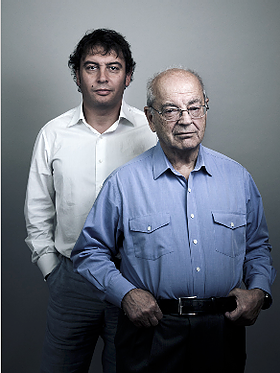
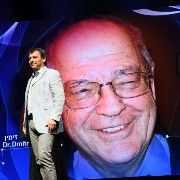
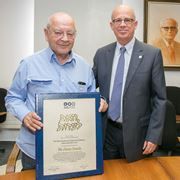
Boris Zimin with his father, the late Dr. Dmitry B. Zimin, Founder of the Zimin Institutes
The Zimin Institute occupies a distinctive place between fundamental discovery and the marketplace. By supporting researchers at the stage when a scientific insight has shown real promise but still carries substantial development risk, it helps address one of innovation's most difficult gaps.
The model also reflects the legacy of the late TAU Honorary Doctor Dmitry B. Zimin, the Russian technology entrepreneur and philanthropist whose vision placed science, education and socially conscious innovation at the center of his philanthropy. Since Dr. Zimin’s passing in December 2021, his son Boris Zimin is continuing his father’s legacy through the Zimin Foundation. At Tel Aviv University, that vision has evolved into an ongoing platform for researchers willing to take ambitious ideas further.
The Institute's story is therefore not simply about the projects it has funded. It is about creating the conditions in which outstanding research can flourish to become a world-changing solution.
Related Articles