

Uncovering Hidden Galaxies
TAU Graduate Student Develops Innovative System for Detecting Hidden Galaxies


Daniel Pakula began conducting active research as early as his second year of undergraduate studies, despite feeling inexperienced at the time.
• As part of his research, Daniel developed an automated system for detecting faint galaxies using the Dragonfly telescope and cosmological models.
• Daniel encourages younger students to get involved in research early: “The best way was simply to try.”
Dwarf galaxies, dark matter, and highly sensitive telescopes: most of us only encounter these concepts in science fiction films. But for Daniel Pakula, these are parts of his normal, daily routine as a master’s student at Tel Aviv University's School of Physics and Astronomy. As part of his research, he is developing systems that help identify faint galaxies that previous surveys failed to detect.
It is highly unusual for an undergraduate student to conduct research, but that is exactly what Daniel did. At the start of his second undergraduate year, he searched for a way that he could join a research project in the Faculty of Exact Sciences. “The best way was simply to try,” he says. More advanced PhD students advised him to “go door to door around the faculty, knock on offices, and ask supervisors to join their work,” even though he lacked the necessary research background and experience.
Daniel eventually connected with his current supervisor, Dr. Shany Danieli, an observational astrophysicist whose research investigates faint and low-mass galaxies beyond our Milky Way Galaxy, which are nearly impossible to detect using traditional methods. His technological background proved crucial to their collaboration.
“She let me lead a broad project they had wanted to do for a long time with data from their Dragonfly telescope—a project that combined a significant technological challenge alongside the physics.”
Now, still early on in his academic journey, Daniel uses the highly sensitive Dragonfly telescope to identify galaxies and test the ΛCDM cosmological model. To do so, he developed an automated galaxy-detection system that has already succeeded in identifying faint galaxies that previous surveys appear to have missed.
“Shany is very hands-on, gives advice, and explains a lot about the physics behind everything,” he says of his mentor. She also supports him with the logistical and bureaucratic aspects of working with the international research group.
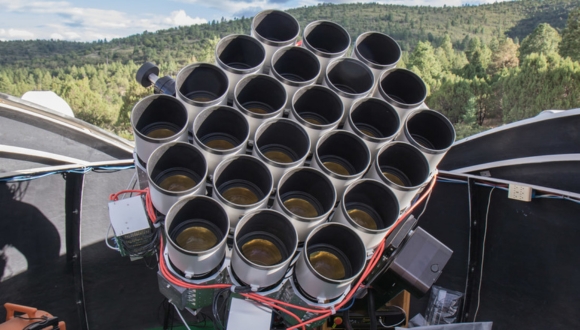
The Dragonfly Telescope (photographed by Dr. Shany Danieli and the Dragonfly team)
Mysterious and Beautiful: The Hidden Side of Astrophysics
Daniel says he has always been passionate about the field of astrophysics.
He notes that much of his inspiration came from science fiction films such as Interstellar, which revealed the beauty of the field beyond mathematics and equations. These films presented a world in which “science tries to predict what things would actually look like in reality, and that fascinated me.”
“There’s something mysterious and incredibly beautiful about astrophysics, and it’s very easy to romanticize,” he explains.
Before university, Daniel worked in cybersecurity research in both the military and industry, but he always wanted to continue learning and broaden his horizons. When he arrived at TAU, he chose a unique academic track combining physics with East Asian studies.
“I wanted to study what attracted me. I’ve been learning Japanese for six or seven years in a pretty hardcore way, and that developed a deep interest in the culture alongside physics.”
What is Daniel Searching for in the Universe?
Dwarf galaxies are extremely small and faint galaxies, making them difficult to detect with ordinary telescopes. Precisely because of this, they are of great interest to researchers: they may provide clues about galaxy formation, dark matter, and the structure of the early universe.
To detect them, Daniel uses the Dragonfly telescope, which is capable of identifying exceptionally faint objects, along with an automated system he developed himself.
Daniel’s research is based on a major cosmological model known as ΛCDM, which describes how galaxies and dark matter evolve throughout the universe over billions of years.
By comparing the model’s predictions with galaxies that are actually observed, researchers can test how well we truly understand the structure of the universe.
Finding the Galaxies Nobody Sees
This is where Daniel’s research comes in. First, he aims to discover as many dwarf galaxies as possible using the Dragonfly. By analyzing telescope images, his system automatically flags objects suspected of being galaxies.
After identifying galaxies, Daniel analyzes their properties and compares them to the predictions of theoretical models. During this process, he developed a system that automatically identifies and highlights galaxy-like objects. So far, the system has already succeeded in detecting faint galaxies that likely escaped previous surveys—another step toward a more accurate mapping of the universe’s structure.
Ultimately, Daniel’s goal is to build a census of dwarf galaxies and statistically assess their completeness.
While some of the algorithms Daniel uses were originally developed within the Dragonfly research group, he is the first researcher to combine them on such a large scale and apply them to extremely large datasets, while also improving and correcting existing issues.
“Get Involved as Early as Possible”
For younger undergraduate students who are hesitant to take their first step into the world of research, Daniel stands by the advice he himself received:
“My advice is just do it. It’s worth getting involved in research as early as possible, without pressure, because it’s fun to be exposed to cutting-edge fields.”
At the same time, he acknowledges that rejection is part of the process: “Most supervisors will say ‘no’ at an early stage, but usually they’re not saying you’re not good enough—they’re simply saying, ‘Come back in another year.’ You only gain from those meetings: you learn about research fields and begin to understand what truly interests you.”
Related Articles