Israeli researchers find that medical clowns contribute significantly to the achievement of medical therapeutic goals




Research
Israeli researchers find that medical clowns contribute significantly to the achievement of medical therapeutic goals
You see them stroll around in the hospitals' toughest wards with their red noses, colorful clothes, and unwavering smiles, spreading laughter and cheerfulness wherever they go. They are the medical clowns: trained professionals whose goal is to change the hospital environment through humor.
A new study tested and categorized the skills of medical clowns and found that their importance goes far beyond contributing to a patient's good mood. The researchers identified 40 different skills of medical clowns, including establishing an emotional connection and creating a personal relationship with the patient, expressing the patient's frustrations and difficulties to the medical staff, increasing the patient’s motivation to adhere to medical treatment, distracting the patient from pain, and creating a joyful atmosphere.
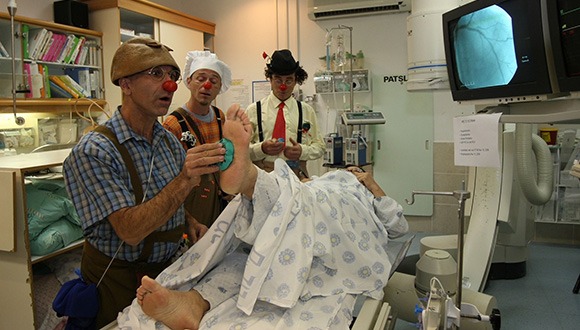
Medical clowns working alongside other therapists (Photo: The Dream Doctors Project, Medical Clowning in Action)
The research was conducted under the leadership of Prof. Orit Karnieli-Miller, with Dr. Lior Rosenthal, both from the Department of Medical Education at TAU's Sackler Faculty of Medicine, in collaboration with Ms. Orna Divon-Ophir, Dr. Doron Sagi, Prof. Amitai Ziv and Ms. Liat Pessach-Gelblum from the Israel Center for Medical Simulation (MSR). The study was published in Qualitative Health Research, a leading journal in the field of health.
The researchers show that not only do medical clowns help the patients and their family members, but also the medical team and the achievement of treatment goals.
Through use of different communication skills, clowns make it easier for the patient to cooperate with various treatments. The medical clowns work in a team with other therapists, know how to intervene and help whenever an argument or crisis should arise to advance treatment.
"From the moment they enter the room, the clowns form a bond with the patients, strengthen them, and give them power and status within the medical system." Prof. Orit Karnieli-Miller.
Studies conducted throughout the years have shown the clowns’ positive influence on the hospital environment through humor, as well as helping patients deal with pain. However, no studies have empirically mapped the skills they use and their therapeutic goals to help understand their “secret magic.” In addition, there was a lack of broad understanding of how clowns can help children, teenagers, and their parents in various challenging situations of distress and difficulty, as well as how they can help patients and medical teams achieve treatment goals. This lack of appreciation of the potential benefits of utilizing the services of medical clowns meant that patients and medical teams would occasionally be reluctant to cooperate with them.
As part of the new study, the researchers focused on qualitative, in-depth systematic identification of the skills of medical clowns through observation and analysis of their actions in challenging encounters with adolescents, parents, and medical staff.
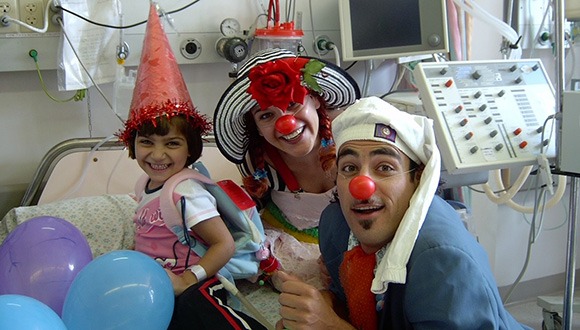
Medical clowns help patients and medical teams achieve treatment goals (Photo: The Dream Doctors Project, Medical Clowning in Action)
The team analyzed videotaped sessions of medical clowns in various simulated situations and conducted in-depth interviews with expert medical clowns. The researchers identified 40 different skills used by the medical clowns to achieve four therapeutic goals:
1) building a relationship and connecting to the needs and desires of the patients
2) dealing with emotions and difficulties
3) increasing the patient’s motivation to adhere to the treatment plan
4) increasing the patient’s sense of control and providing encouragement to patients
The clowns examined in the study were trained and recruited by the "Dream Doctors Project”, a non-profit association that employs medical clowns as part of the paramedical system in Israeli hospitals, and trains them to work within multi-disciplinary teams. The Tel Aviv University researchers collaborated with the Israel Center for Medical Simulation (MSR), which created a simulation-based workshop focused on developing the skills of experienced medical clowns.
"From the moment they enter the room, the clowns form a bond with the patients, strengthen them, and give them power and status within the medical system," explains Prof. Karnieli-Miller. "They do this through an initial connection to the patients’ voice, and even to the patients’ reluctance to implement therapeutic recommendations - an emotional connection that often results in the patient changing their position and cooperating with the medical staff."
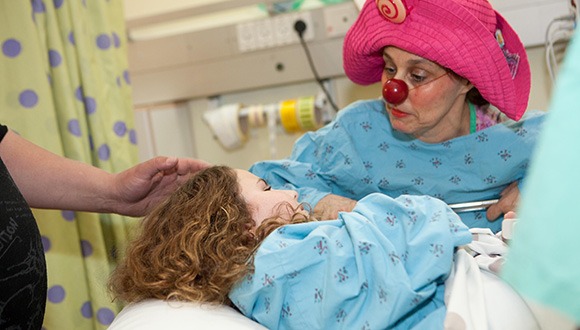
Providing the patient with an increased sense of control and courage to face their challenges (Photo: The Dream Doctors Project, Medical Clowning in Action)
According to Prof. Karnieli-Miller the medical system is hierarchical, and it is not always easy for patients to navigate. Therefore, one of the skills of medical clowns is to place themselves in the lowest position in the medical setting. By doing so, they empower the patients by giving them a sense of power and control, including the choice of whether to allow the clown to enter the room as well as to dictate the nature of the patient’s role vis-à-vis that of the clown. This provides the patient with an increased sense of control and courage to face their challenges.
The researchers emphasize that the clowns are very aware of the emotional difficulty associated with staying in a hospital and dealing with an illness. To help deal with these issues, the clowns sometimes distract the patient by using props, humor, and imagination. Other skills include allowing the patient to direct their frustrations towards them, away from medical staff or parents.
Depending on the situation the clowns may also use a comforting touch, soothing music, empathetic listening, or a reinforcing statement to provide an environment where the patient feels comfortable to express their feelings. A patient’s ability to gain legitimacy is important and is strengthened by the clowns.
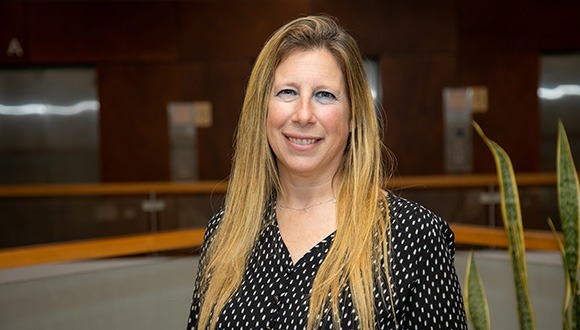
Prof. Orit Karnieli-Miller
"Mapping the skills and goals of the medical clowns improves their understanding of their role and may help other health professionals appreciate their work methods and the benefits of incorporating these methods into their own practices when faced with similar challenges" Prof. Orit Karnieli-Miller.
"Mapping the skills and goals of the medical clowns improves their understanding of their role and may help other health professionals appreciate their work methods and the benefits of incorporating these methods into their own practices when faced with similar challenges,” adds Prof. Karnieli-Miller.
"This research is important because it allows the clowns to enhance their training program and refine their diverse skills to achieve the various therapeutic goals appropriate for different patients, as well as helping health professionals collaborate with the medical clowns. If professionals in the healthcare field gain a clear understanding of how and when to cooperate with the medical clowns, they will be able to help patients overcome challenges, and at the same time they may be more tolerant of the clowns' ‘disruption’ of the hospital care regimen. This appreciation of the clowns’ contribution will provide the clowns with the time and space to connect with patients and help and encourage patients to become more active participants in their treatment plan,” she concludes.

Research
Tel Aviv University researchers monitored the physiological data of close to 5,000 Israelis over two years
In a first-of-its-kind study, researchers at Tel Aviv University equipped close to 5,000 Israelis with smartwatches and monitored their physiological parameters over two years. Of those monitored, 2,038 received the booster dose of the coronavirus vaccine, allowing the researchers to objectively compare measures before and after the participants took the vaccine, and confirm its safety.
In addition, in collaboration with the Kahn Sagol Maccabi Research & Innovation Center (KSM - the research and innovation institute of the Israeli Maccabi Healthcare Services), the researchers examined the safety of the booster by analyzing the medical files of 250,000 members of Maccabi Health Services anonymously (without identifying details) and with the approval of the Helsinki Committee. From the analysis of this large amount of data, the researchers were able to evaluate the safety of the vaccines from three perspectives: subjectively - what the participant reports, objectively - what the watch detects, and clinically - what the doctor diagnoses.
"We saw clear and significant changes after administration of the vaccine (…) and then we saw a return to the participant’s baseline, i.e., the pulse levels after vaccination returned to their previous levels after six days. Hence, our study confirms the safety of the vaccine." Prof. Dan Yamin
The research was carried out by PhD student Matan Yechezkel under the supervision of Prof. Dan Yamin, Head of the Laboratory for Epidemic Research and led in collaboration with Prof. Erez Shmueli, Head of the Big Data Laboratory, all from The Iby and Aladar Fleischman Faculty of Engineering at Tel Aviv University. Other collaborators were Dr. Tal Patalon and Dr. Sivan Gazit, Director and Deputy Director, respectively, of KSM, as well as Dr. Amichai Painsky and Ms. Merav Mofaz from Tel Aviv University. The results of the research were published in the prestigious journal, Lancet Respiratory Medicine.
As Prof. Yamin explains: "We wanted to test the safety of booster vaccines against the coronavirus. We conducted a large-scale, two-year clinical study during which we equipped 4,698 Israelis with smartwatches. The smartwatches were used to monitor several parameters such as heart rate, variation in heart activity, quality of sleep, number of daily steps taken, and more. In addition, the participants were asked to fill out daily questionnaires about their health status in a customized application that we developed. Finally, we analyzed data on potential unusual events from the medical files of a quarter of a million randomly selected, anonymous, insured members of the Maccabi Health Services."
Since the medical file contains the date the booster vaccine was administered, researchers were able to compare the condition of the vaccinated patient with his/her baseline condition from 42 days before receiving the vaccine to the condition of 42 days after receiving the vaccine. The data was obtained from the questionnaires, smartwatches, and records of the Maccabi Health Fund.
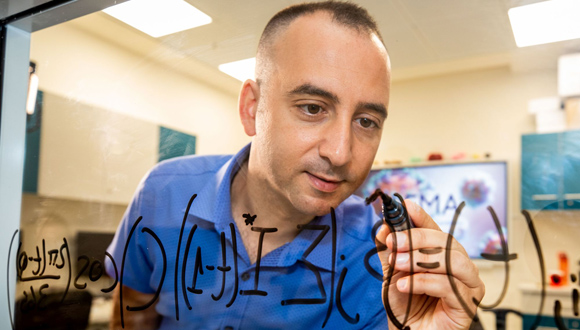
Prof. Dan Yamin
"We saw clear and significant changes after administration of the vaccine, such as an increase in heart rate compared to the pulse rate measured before vaccination," says Prof. Yamin, "and then we saw a return to the participant’s baseline, i.e., the pulse levels after vaccination returned to their previous levels after six days. Hence, our study confirms the safety of the vaccine."
"The research also allowed us to compare subjective and objective indicators and medical diagnosis of the same participant who received the first booster and a few months later the second booster," explains Prof. Yamin and adds, "We found no difference in the physiological response recorded by the smartwatches and that reported by the participant in the app."
"The smartwatch sensors 'felt' that the vaccine was safe, the vaccinee himself reported that the vaccine was safe, and finally, the doctors determined that the vaccine was safe. The results of the study have far-reaching implications regarding objective testing of vaccine safety in the future." Prof. Dan Yamin
In the medical literature, twenty-five unusual side effects attributed to the Corona vaccine were reported, and the researchers paid special attention to look for rare cases of inflammation of the heart muscle (myocarditis) and pericarditis. Prof. Yamin and his colleagues checked the frequency of these unusual side effects among a quarter of a million Maccabi members and found no increase in serious incidents of any kind associated with vaccination.
Prof. Yamin concludes: "If the watch reports any minor changes in the muscles, and the participant reports only significant changes he feels, the medical file tells us about unusual events diagnosed by the doctors as well as hospitalizations that may be related to vaccinations, with an emphasis on cardiac events. We did a comprehensive analysis of all those twenty-five unusual side effects, and we did not see an increase in their incidence among those receiving the booster. We found the vaccine to be safe to use. The smartwatch sensors 'felt' that the vaccine was safe, the vaccinee himself reported that the vaccine was safe, and finally, the doctors determined that the vaccine was safe. The results of the study have far-reaching implications regarding objective testing of vaccine safety in the future.”

Research
Tel Aviv University researchers successfully identify new viruses, even specify which organisms they are likely to attack
A groundbreaking Tel Aviv University study has discovered about 100,000 new types of previously unknown viruses – a ninefold increase in the amount of RNA viruses known to science until now. The viruses were discovered in global environmental data from soil samples, oceans, lakes, and a variety of other ecosystems. The researchers believe that the discovery may help in the development of anti-microbial drugs and in protecting against agriculturally harmful fungi and parasites.
The study was led by doctoral student Uri Neri under the guidance of Prof. Uri Gophna of the Shmunis School of Biomedicine and Cancer Research in The George S. Wise Faculty of Life Sciences at Tel Aviv University. The research was conducted in collaboration with the US-based research bodies NIH and JGI, as well as the Pasteur Institute in France. The study was published in the prestigious journal Cell, and comprised data collected by more than a hundred scientists around the world.
Viruses are genetic parasites, meaning they must infect a living cell to replicate their genetic information, produce new viruses, and complete their infection cycle. Some viruses are disease-causing agents that can cause harm to humans (such as the coronavirus), but most viruses do not harm us – some of them even live inside our bodies without us even being aware of it.
"One of the key questions in microbiology is how and why viruses transfer genes between them. We identified several cases in which such gene exchanges enabled viruses to infect new organisms." Prof. Uri Gophna
Uri Neri says that the study used new computational technologies to mine genetic information collected from thousands of different sampling points around the world: oceans, soil, sewage, geysers, and more. The researchers developed a sophisticated computational tool that distinguishes between the genetic material of RNA viruses and that of the hosts and used it to analyze the big data. The discovery allowed the researchers to reconstruct how the viruses underwent diverse acclimation processes throughout their evolutionary development to adapt to different hosts.
In analyzing their findings, the researchers were able to identify viruses suspected of infecting various pathogenic microorganisms, thus enabling viruses to control them. “The system we developed makes it possible to perform in-depth evolutionary analyses and to understand how the various RNA viruses have developed throughout evolutionary history," explains Prof. Gophna. "One of the key questions in microbiology is how and why viruses transfer genes between them. We identified several cases in which such gene exchanges enabled viruses to infect new organisms."
"Furthermore, compared to DNA viruses, the diversity and roles of RNA viruses in microbial ecosystems are not well understood. In our study, we found that RNA viruses are not uncommon in the evolutionary landscape and, in fact, that in some respects they are not that different from DNA viruses. This opens the door for future research, and for a better understanding of how viruses can be harnessed for use in medicine and agriculture.”

Research
Israeli researchers developed innovative device designed to prevent harm caused to flying animals, in particular bats
Every year, wind turbines around the world kill millions of bats and other flying animals that fly into the turbine's blades. A new study by Tel Aviv University and the University of Haifa offers an original solution to the biological challenge of wind turbine operation and helps prevent harm caused to flying animals, in particular bats: a unique drone-mounted technology that transmits a combination of ultrasonic signals and lights. This deters the bats and leads them to fly at a higher altitude, outside the danger zone, thereby allowing the turbines to continue to operate efficiently and continuously.
"Our study was the first in the world to combine these technologies – RADAR, LIDAR and high-altitude acoustic recorders – to track bats." Yuval Werber
The study was conducted under the leadership of doctoral student Yuval Werber of the Department of Evolutionary and Environmental Biology at the University of Haifa and his two supervisors, Prof. Yossi Yovel, head of Tel Aviv University’s Sagol School of Neuroscience and faculty member of the School of Zoology, and Prof. Nir Sapir, the Head of the Department of Evolutionary and Environmental Biology at the University of Haifa, and in collaboration with the company WinGo Energy and the entrepreneur Gadi Hareli. The article was published in the journal Remote Sensing in Ecology and Conservation, and the study was funded by a research grant from the Israeli Ministry of Energy.
“Wind turbines are considered a promising technology in the field of renewable energy, but their operation involves a variety of biological challenges," explains Prof. Yossi Yovel, Kadar Family Award for Outstanding Research recipient. "Today, the only solution to prevent the death of bats is to stop turbine activity at times when the bats are expected to be particularly active. But such interruptions reduce the turbines’ efficiency and the amount of energy they can produce."
"The advantage of the drone is that it is in constant motion and transmits a combination of visual and acoustic signals designed specifically for bats, warning them of danger. When signals are stationary and constant, animals tend to get used to them and eventually ignore them.”
Yuval Werber shares that, “the study, which is part of my doctoral thesis, was conducted in the Hula Valley, an area with a lot of bat activity. We operated the drone at a height of 100 meters – the average height of the center of a wind turbine, and in motion along a path of about 100 meters, back and forth."
"To track the bats’ activity, we used RADAR located on the ground, which allowed for tracking at a height of 100 meters and above, and we added a LIDAR device – a laser-based tool that is used to detect objects at short distances, mainly in the automotive industry – for tracking at a lower height. At the same time, we made acoustic recordings of the bats in flight, using receivers placed at three different heights: one meter, 150 meters, and 300 meters. We used a blimp to elevate the receivers. Importantly, our study was the first in the world to combine these technologies – RADAR, LIDAR and high-altitude acoustic recorders – to track bats.”
"On the one hand, it prevents the killing of bats, and on the other hand, it enables the operation of the turbine and the production of green energy in a safe, continuous and efficient manner." Prof. Yossi Yovel
Using a variety of monitoring methods, the researchers compared the bats' normal activity with their activity in the presence of the drone carrying the deterrent device. The findings were unequivocal – the device succeeded in keeping the bats away. With the drone’s presence, the bats’ activity underneath it decreased by about 40 percent, at a distance of up to about 400 meters. On the other hand, their activity increased above the drone’s altitude of 100 meters, up to 800 meters.
“It appears that the device is effective in repelling bats from its immediate environment – the bats sense the visual and ultrasonic signals it emits and choose to fly over it, as we had hoped,” says Prof. Yovel.
“We hypothesize that if the device is activated near a turbine, it will lead the bats to fly over the turbine and out of harm’s way. This is an effective and easily-implemented solution that is reasonably priced, with great benefit to all parties: on the one hand, it prevents the killing of bats, and on the other hand, it enables the operation of the turbine and the production of green energy in a safe, continuous and efficient manner. We intend to carry out a follow-up experiment on a wind turbine site, in order to test the efficiency of the device under these conditions.”