
Redefining Learning: Inside Tel Aviv University’s Celebration of Teaching Innovation
What does higher education look like in the future?


Mission: Creating active, human-centered learning experiences
that prepare students for a rapidly changing world.
AI-powered medical training
Museum-based history research
Biotech entrepreneurship from lab to startup
Medical students practicing difficult clinical conversations with AI-powered simulators. Liberal Arts scholars uncovering Jewish history through real interactions with museum artifacts. Undergrads launching and raising funds for their own startups.
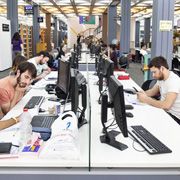
At Tel Aviv University (TAU), these innovations in learning are already happening: in botanical gardens, virtual reality labs, film studios, and modern classrooms where students have transitioned from passive listeners to active creators.
This evolution took center stage at the fourth annual Conference on Innovation and Creativity in Teaching, hosted by the Dean’s Office for Innovation in Teaching and Learning. An important cornerstone of the university’s mission, the conference promotes engaged, interdisciplinary, and forward-thinking education.
This year’s theme, “Blurring Boundaries,” highlighted a growing reality: learning no longer fits neatly within traditional academic frameworks. Led by Dean Prof. Inbal Yahav, Vice Dean Prof. Arnon Hershkovitz, and Associate Dean and Head of Pedagogy Ortal Engelberg, the event brought faculty together to bridge technology and pedagogy, take classrooms beyond their walls, and reimagine higher education.
From Ideas to Impact
Throughout the year, the Dean’s Office collaborates with lecturers to design new courses and revitalize existing ones. Yaara Hutzen, a pedagogical consultant on the professional development team, notes that the process always begins with a foundational question: "What do you want students to be able to do when they finish the course?"
"When a lecturer comes to us with a raw idea, we help turn it into a structured learning experience," Hutzen explains. "We ask the right questions and help translate educational goals into meaningful student engagement."
This impact was highlighted during the presentation of the Rector’s Award for Innovation and Creativity in Teaching, which honors faculty members transforming the student experience.
This year's award-winning initiatives included:
• Public History: A museum-based research seminar that pulls history out of textbooks and into public spaces.
• AI in Medicine: An AI-driven simulator that helps medical students practice delivering difficult news with empathy.
• Biotech Entrepreneurship: A three-semester course immersing students in every stage of building a biotech startup, from scientific discovery to fundraising.
A Conference Beyond the Auditorium
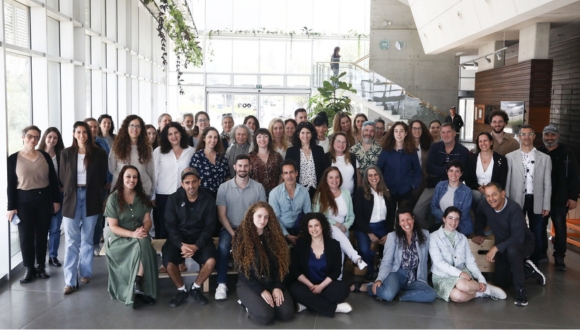
The team behind the TAU Dean Office for Innovation in Teaching and Learning
Fittingly for an event dedicated to blurring boundaries, the conference itself broke out of the traditional lecture hall. The day kicked off with four immersive campus tours, offering participants hands-on perspectives on alternative learning environments. Educators explored the Yehuda Naftali Botanical Garden as a living classroom, experienced virtual reality applications and special collections at the Sourasky Central Library and visited the Dean’s Office Media Studio to see how faculty can produce high-quality digital content for online teaching.
The sessions prioritized active engagement over passive listening. A panel discussion on AI in education utilized the "fishbowl" method, featuring a "hot seat" on stage that invited audience members to seamlessly join the panel and contribute to the debate. In another unscripted highlight, Prof. Yoram Reich staged an intervention from the audience to pose a deceptive question: What should educators do when they make mistakes? The resulting discussion emphasized the vital role of vulnerability and continuous learning for instructors and students alike.
Keynote presentations further tackled the complex relationship between technology and the human mind. Dr. Shir Etgar examined how screen time shapes attention spans and cognitive processing, while Prof. Lior Zalmanson drew unexpected parallels from consumer platforms like Tinder and Spotify to decode modern student engagement and classroom dynamics.
Innovation Beyond Technology
Despite the heavy presence of cutting-edge tech, organizers emphasized that true innovation should not be confused with mere digital novelty.
"Innovation doesn't necessarily mean replacing what already works," says Hutzen.
"Many of our award-winning courses are actually built on teaching principles that have existed for centuries."
The ultimate goal is to foster curiosity, participation, and human connection. Whether through artificial intelligence, experiential learning, or time-tested pedagogical techniques, great teaching relies on engaging students as active partners.
By investing in these methods, the Dean’s Office is shaping an academic culture at Tel Aviv University that is creative, human-centered, and built to prepare the next generation of thinkers, creators, and leaders.
Related Articles